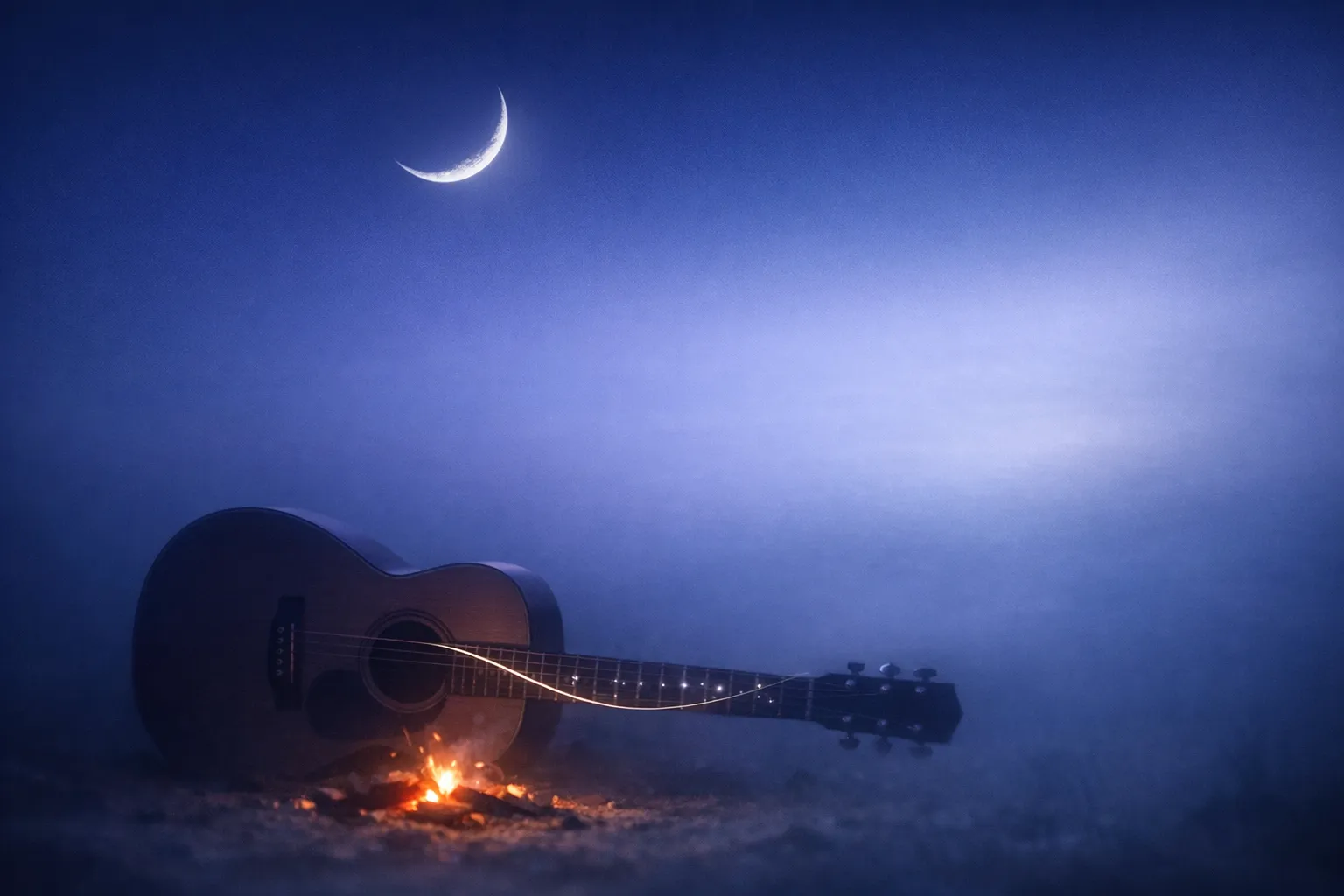
Symphonic Stargazing
You hold the guitar like a night compass, the campfire stitching little suns into the dark as sparks lift and fold into the sky. The quarter moon leans over your shoulder, a silver metronome that clicks in steady halves – waning or waxing, it’s the moon’s way of saying “edit, refine, choose your next note.” You breathe, lift your fingers, and let a chord tumble out that you didn’t plan. It isn’t perfect – there’s a gentle buzz on the low E – but it rings like a shy bell. And then something happens. The air listens back. The pines hush a fraction. The chord feels as if it’s drawn a chalk circle around your heart, and for a beat or two, you stand in it.
I’ve seen this before: the subtle nod between sky and sound, two invisible instruments playing one slow duet. You strum again, and a phrase curls free, unremarkable at first – G, D, a slide up to a bright A. The pattern repeats, like footprints you suddenly notice only after you’ve stepped through them three times. And somehow, the sequence starts to carry a shape, a mood, a wordless sentence. This is the moment the quarter moon is famous for. It’s the crossroads phase, the hinge in a door. A “quarter” in the sky is not a coin to spend but a measure in the song – time carved into even bars, a page folded so you can find your way back.
Consider how you tune: A string to D, D to G – intervals stacked like the ribs of a celestial harp. The constellations are not mere connect-the-dots; they’re mnemonic devices of light, guiding stories across lonely distances. Your fretboard is the same – dots at five, seven, nine – a subtle star map under your fingertips. When you lift a run of notes, you’re not inventing a message so much as translating one from the wind’s low hum and the fire’s crackle-tongue. Your ear becomes an eyepiece. You scan, feel a kind of acoustic gravity pull your hands where they were already going, and play what was waiting there.
The quarter moon, that practical mystic, prefers clarity over drama. It prods gently: peel away extra strums. Hold the note longer than comfort says you should. If a chord looks back at you, listen. I find that a single tone, allowed to bloom and decay, can say more than a flurry of cleverness. Let it ring and let the silence around it do half the speaking. You may notice your breath syncing with the firewood’s slow exhale; the body is a percussion section even when you’re sitting still. And the night? It’s a listening room with the roof off, where the cosmos applauds with cricket cymbals.
When a certain tone stings with sweetness, or when your hands keep returning to a voicing you “didn’t mean” to play, treat it as a soft omen. Not a billboard in neon, just a ribbon tied to a branch you might have missed in daylight. The sky often whispers its approval not with thunder but with a subtle slipstream: birds quieting, an ember popping right at the downbeat, a shooting star that seems timed with your change to minor. You don’t need to prove any of it. You only need to be there with your strings and your listening. The message is less about meaning and more about meeting – what arrives when the ear and the night hold each other just long enough for a note to tell the truth.
And if you wonder whether it’s your imagination, good. Imagining is the first language of divination, the soft graphite that sketches the path before ink commits. Your fingers translate; the moon edits; the fire publishes. You’re not only playing a song – you’re participating in the sky’s quiet rehearsal for dawn, where every chord is a constellation that temporarily holds before drifting to a new formation. Keep strumming. Each repetition burnishes the omen from an impression into an invitation.
The Cosmic Chord: Discovering Messages in Sound
Imagine the guitar as a vessel the night has been waiting to speak through. A chord is not merely stacked frequencies; it’s an arrangement of tensions and releases – tiny tug-of-wars that sound like feelings. Astrology thrives on these tensions too: squares press us to act, trines persuade us to glide, oppositions nudge us to negotiate our own mirror. You don’t need to memorize the sky’s blueprint to sense its pull. In the glow of the campfire, your ear can tell the difference between a buttery major chord and the dusk-colored ache of a minor. Those differences carry omens the way the tide carries salt – subtle, consistent, undeniable.
Here’s how a message often arrives through sound: not as dictation, but as gravitation. Your hands reach the same chord twice, then thrice. Maybe it’s a suspended shape – a chord that won’t fully open or close – hovering on the fretboard like a question mark made from wire. Suspended chords are beautiful stargazers; they hang between decisions, pulling your awareness to the exact threshold you keep revisiting in your life. You hold it, feel your chest widen a little, and resolve the chord only when you’re ready to complete the sentence. The omen is in that patience. It says: stay with the in-between until the next step grows a name.
Quarter moons, in their balanced tension, favor this kind of hovering insight. They slice the month into clean quarters the way measures divide a song: countable, breathable, navigable. If full moons are orchestral finales and new moons are gentle overtures, the quarter is practice time, metronome-click honesty. Play a progression you think you know, but let the night edit your sequence. The “wrong” note you keep landing on might be a call from the cosmic ear asking you to pivot – down-tune a relationship, up-tune a habit, or add a seventh where you’ve been insisting on a tidy triad. Sevenths, after all, make things human; they turn the posture of a chord into a story with creases and warmth.
When I listen for messages, I also watch how the body responds. Does a note bring a sudden inhale? Do your shoulders loosen when you move up the neck? That’s your built-in diviner, the somatic star-reader that predates books. The body holds yes and no in its sinews. We often overlook it, expecting prophecy to ride in on thunder; instead, truth arrives on a harmonic that lands in your sternum like a small, kind stone. And the setting – the cedar, the moths, a river trudging in the dark – gives context. Natural rhythms are forgiving teachers. The crickets know their tempo; so does your pulse. If a rhythm catches on a snag, slow down. Let the downbeat align with your breath rather than your eagerness.
There’s a kind of rune-casting that can happen with sound alone. Runes are ancient characters carved into wood or stone, each with a symbolic current. You can “cast” musical runes by drawing three quick shapes out of your muscle memory without planning: a bass run, a bright treble arpeggio, and a chord that lands with authority. Treat them like pulled tiles. The first shows the context – what the night already knows. The second reveals the moving piece – what shifts easily if you invite it. The third is the counsel – where to place your faith for now. Don’t overthink. The fire likes one-take honesty. If the counsel chord happens to be a quietly stubborn D minor that refuses to cheer up, accept its wisdom. It may be saying, tend the roots, not the fireworks.
The music you “accidentally” play is often more candid than the songs you practice. Accident is only what we call the part of us that speaks faster than we admit we’re listening. And if you find a short motif looping, see what picture it paints in your mind’s skylight. Perhaps a road disappearing into blue dawn, or a door ajar in a hallway of sleep. No need to decode every symbol like a locksmith. Let them be lanterns. You’ll know the omen has landed when you feel that amused calm, the one that says, I already knew this, didn’t I? The night isn’t telling you what to do so much as reminding you of the interval where your own voice lives.
From Strings to Stars: Why Music Speaks to the Soul
The soul understands intervals the way birds understand thermals. We rise on what we cannot see because it carries us without argument. Play long enough under the quarter moon and you begin to feel how the heavens thread their loom through your chords. Astrology is a language of rhythm and resonance, not a courtroom of proofs. Planets don’t bark orders; they murmur tempos. When Mars stirs the embers, we downstroke with a little more edge. When Venus hums from the soft underbelly of the sky, we sway to sweeter voicings. Even if you’ve never met a birth chart, you’ve felt these seasons glide across your life – times of sharpness, times of slow syrup, times when everything arrives in threes like a waltz that’s been waiting for your feet.
That quarter-sliced moon is the tutor reminding you to practice. Not to perfect, but to become porous – an instrument that the night can play back. Rune casting adds a tactile magic to the moment. If you’ve brought a small pouch of runes, you might draw one between songs, not as a verdict but as a color swatch. Fehu’s flame might tip your strum toward resourcefulness; Ansuz, breath and communication, could nudge you to sing a line you were shy about. Or make your own runes from guitar picks – mark them with simple sigils: a wave, an arrow, a leaf. Cast three into your open palm and match each to your next musical choice: tempo, key, lyrical image. You’ll feel less like you’re forcing an omen and more like you’re inviting one to sit down with you and warm its hands by the coals.
And if the night grows bold, you could weave a tiny ritual right into the set:
- Strike a single note and hold it until the fire answers with a pop. That’s your opening gate.
- Play a progression that feels like your current question. Don’t name it; let the strings describe it.
- Draw a rune or a marked pick. Match its “mood” to a new chord you wouldn’t usually choose. That’s the twist in the tale.
- End with silence long enough to hear the river of insects. Their applause seals the message.
None of this is about being right. It’s about being tuned. Music reaches the soul because it sidesteps debate and speaks in tides. Sound waves tap the body’s old doors: bones carry bass like secret hallways; skin listens to micro-rasps; lungs measure phrasing. The campfire setting returns you to the simple chamber where intuition rings clearest. No stage lights, no clever pedals, just wood, wire, air, and the lunar quarter counting time like a lighthouse that pulses instead of shouts.
I’ve noticed that future choices often announce themselves as a key change you can’t resist. You might be mid-story in G when your fingers insist on F – lower, humbler, truer for now. Or you climb to B minor and realize a melancholy has been waiting politely to speak, and once it does, you feel lighter, not heavier. That’s guidance, not gloom. It’s how the inner weather says, carry an umbrella of patience, the storm will become a garden. If you choose to seek a more formal mirror later – tarot laid on a picnic blanket, or a quiet psychic reading – bring the riff that found you tonight. Let it score the session so you remember how the message sounded, not just what it said.
The sky loves a refrain. Over the next weeks, listen for that campfire motif sneaking into your day. Kettle whistles, elevator dings, the spaced hush of passing cars – tiny metronomes stitching continuity through the ordinary. When the motif reappears, that’s the constellation checking in, a gentle ping from the vastness. You can answer without words. Tap the rhythm on your thigh, hum under your breath, or look up and nod to the moon at wherever she’s carved herself to size. The stars don’t demand devotion; they invite participation. And your guitar – scuffed, loyal, smelling faintly of smoke – remembers the conversation even when you forget. Pick it up at dusk, press your ear to the body, and you might hear last night’s chord still breathing there, a small, steady ember of sound waiting for you to add air and a little courage.
In the end, the messages are simple because we are. Keep the chord that lets your chest open. Loosen the one that makes your jaw tight. Rest more beats between thoughts. Ask the fire your questions and let the smoke draft them upward in looping cursive. Then play. The universe answers in vibrations. The quarter moon just helps you count. And somewhere between the sparks and the cicadas and the low, sure hum of a single note left to ring, a constellation leans down through the strings and becomes, for a moment, something you can hold.

