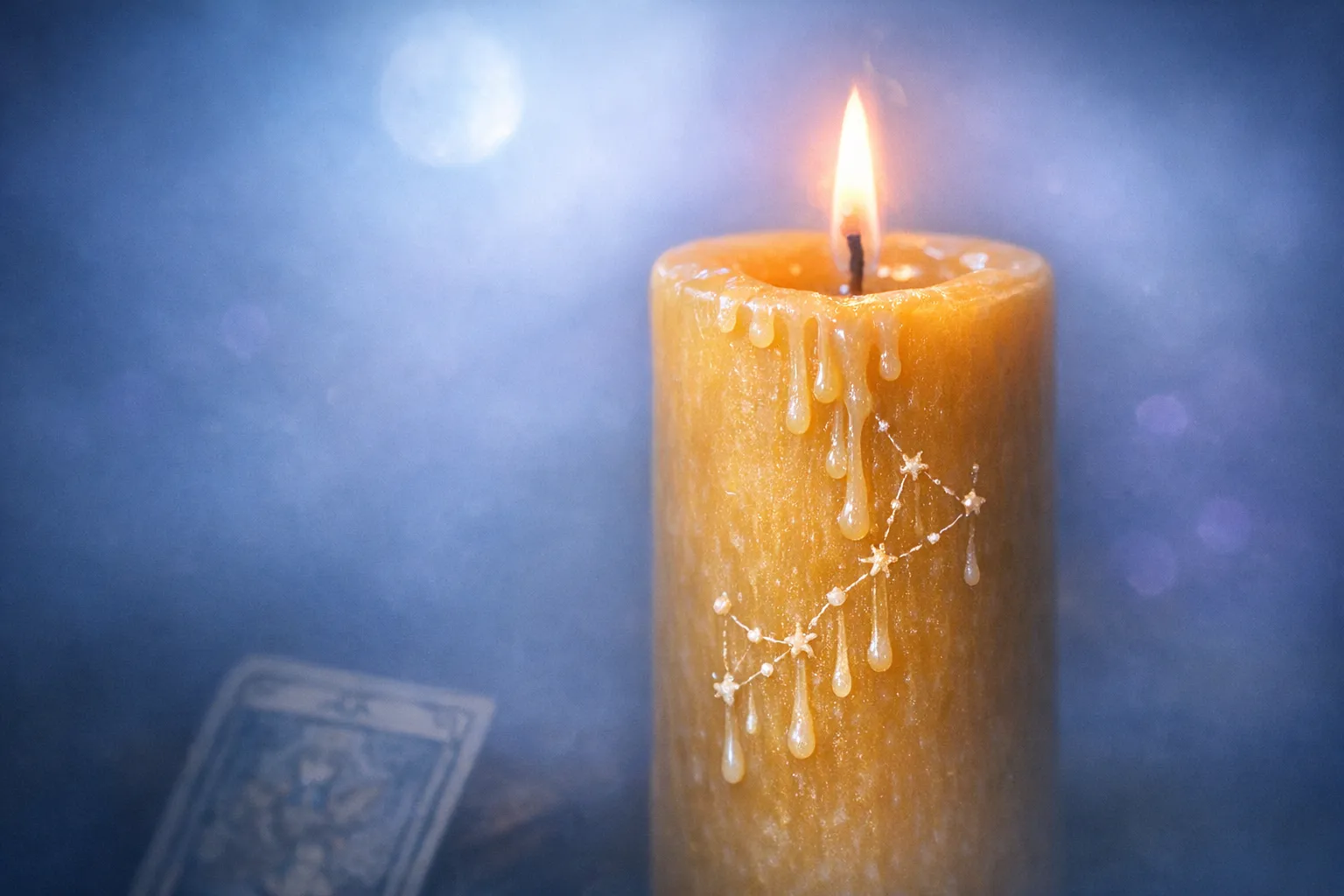
When Wax Whispers Secrets
Here’s a surprising fact to start: before people traced constellations across the night, they saw them in melted tallow. Long before astrology apps and moon calendars, a pool of cooling wax was a pocket planetarium, quietly arranging celestial puzzle pieces along a saucer’s rim. You already know this instinctively. You stare into flames to think. You notice patterns in clouds. Your mind, the oldest diviner, can’t help but give shape to mystery. Candle drips are simply another mirror – warm, pliable, and patient.
During eclipse season – the stretch of weeks when the Sun, Moon, and Earth line up like a trio of watchful owls – those mirrors feel extra shiny. Eclipses, in astrological language, stir thresholds. They’re mythic intermissions when the usual lighting of the world dims and your inner theater gets louder. You don’t have to measure it; you feel it in the way time wobbles, in the sudden urge to clean your altar or text an old friend. If a candle burns in that threshold and leaves behind a melted message, we take the hint and read.
You might be tempted to rush into “What does it mean?” but first, notice the voice of the wax. Fast drips speak in excited syllables; slow drips offer long vowels of patience. Puddles gather like commas, pausing the sentence, while spires point like exclamation marks. The flame is the storyteller; the wax is its handwriting. Let your eyes soften. Tilt the saucer. Turn the plate until the pattern clicks, the way Orion snaps into view once you stop trying to see him.
Now picture this: eclipse night, a still room, your breath settling into a tolerant hush. A bead slides down and fans out; another threads across the rim. Then the shape arrives – you’d swear it’s a dragon, all arc and coil, its back studded with tiny constellations of droplets. In many traditions, dragons guard gates and teach the art of molting. Transformation isn’t always a tidy butterfly moment; sometimes it’s molten, a skin left behind in shining curls. You don’t need to be certain. Just be curious. The wax didn’t arrive to grade your intuition; it came to play.
Melting Moments of Magic
Consider the candle as a tiny observatory. The wick is your telescope, the flame your wandering star, the wax a sky that moves even when you can’t see it shift. Each drop is a planet sliding into place, each tendril a meteor trail across soft terrain. The magic is ordinary, which is what makes it trustworthy. The ordinary always tells the truth – with a wink.
People worry they’re “doing it wrong.” There is no wrong. There are only choices. White wax tends to magnify what you want to see clearly; black wax favors composting what you’re ready to release; beeswax brings a honeyed tone to guidance, like advice from a gentle elder. But you could light a cinnamon-red stub from your kitchen drawer and receive a masterpiece. Intention is the compass; the color is the coat. If “retrograde” crosses your mind – those periods when a planet appears to move backward and life feels like it’s tapping the brakes – simply welcome it as a review chapter, a gentle rewind button in your sky. Review chapters are excellent nights for interpretive wax, because the story is already looping back to find you.
If you like anchors, try an easy ritual skeleton. Not a strict recipe – more like a dance card:
- Set the space: a saucer, a safe surface, maybe a bit of salt or water nearby to ground the room’s edges.
- Name your question in one sentence. Shorter is kinder.
- Light the candle and watch without hunting. Let patterns come to you like shy cats.
- When you sense the “click,” snuff the flame. Don’t blow; invite a soft ending.
- Journal a few phrases you notice before the mind edits them away.
Eclipses have their own percussion. If the candle tunnels (burning a hole straight down), think private passages and truths in the marrow. If it tears a crescent along one side, the Moon is signing its name. If it spits tiny beads, something wants to be said faster than you’re saying it. None of this is a rule, only a grammar you’re learning by ear. You’re not decoding the universe; you’re making conversation with it.
Cosmic Clues in the Patterns
Let your eyes gather shapes like seashells. A ring forms: think vows, cycles, or a promise returning with new context. A ladder: ascent through effort, steps you can name. A river: momentum, but with curves – progress that rides intuition more than plans. A leaf: photosynthesis of the soul; take in more light, exhale more story. A key: access; you already carry what opens the next door. The beauty is not in correctness but resonance. If a spiral looks like a galaxy to you, it is one – for this moment – because your heart recognized that language first.
The dragon from our anchor example is a classic eclipse messenger. In many sky myths, eclipses were thought to be dragons or serpents swallowing the luminaries. Astrology echoes that memory in the nodes of the Moon – sometimes called the dragon’s head and tail – points that suggest where we’re growing toward and what we’re shedding. If a dragon arcs across your saucer on a lunar eclipse, transformation is not a metaphor; it’s choreography. Ask: which skin itches to slip free? Which treasure under your ribs wants air?
You might spot constellations, too. A three-pronged trident could be your inner oceanographer waking up. A cluster of tiny dots might be the Pleiades reminding you of sisterhood or tribe, even if your tribe is plants, books, or late-night playlists. A crooked “M” might echo the scorpion’s glyph or the tides of feelings you keep behind polished words.
A tarot card can time the message. Draw one after the candle cools. If you pull Temperance with a wax river, it’s time to blend streams. If you pull the Tower with spiky stalagmites, let what’s brittle fall – better a chosen crumble than a surprise one. The Star with a scatter of glitter-like specks? Trust the quiet repair. Tarot isn’t a judge here; it’s a clock, pointing to the hour of the theme that’s already unfolding on the plate.
And when nothing looks like anything? That’s its own constellation: the sacred blur. It says, “Rest your interpretations; live a little, then look again.” Blur-days often precede the clearest messages. Patience is also a pattern.
Eclipse Season, Dragon Roads, and Tarot Timing
Eclipse season is a hinge in the hallway – the doors don’t fully close or open; they hover. In that in-between, wax reads like a map scrawled by a traveling cartographer who believes in shortcuts and scenic routes. You don’t have to track the nodes or memorize eclipses by sign (unless that lights you up). Just notice your body’s weather. Do you feel pulled to rearrange your room, your schedule, your self-story? That’s an eclipse talking through your furniture and calendar. Let the candle witness it.
A lunar eclipse tends to tug at the tides inside – the Moon is the keeper of moods, memory, and midnight kitchens. Messages may arrive as animals, faces, oceans, cups, moons within moons. A solar eclipse leans toward identity, focus, the way you introduce yourself to the world. Expect crowns, suns, spines, roads, and tools: chisels, pens, steering wheels. If both arrive in one season, consider it a duet: internal symphony meeting external stagecraft.
Timing with tarot can be playful. After an eclipse burn, pull a single card and listen for tempo:
- Wands heat up the timeline – weeks, sparks, rehearsals become performances.
- Cups ebb and flow – give it a lunar cycle, watch feelings infuse facts.
- Swords clarify fast but integrate slow – news breaks quickly; acceptance takes a beat.
- Pentacles move like mountains – steady, tangible, worth the patience.
Imagine two mini-cases. First: during a lunar eclipse, your candle pools into a crescent hugging a tiny circle – the egg-in-nest shape. You draw the Empress. This hints at nourishing the idea you almost dismissed; grow it in privacy till it kicks. Second: at a solar eclipse, the wax builds a ridge like a backbone with side-branches. You pull the Chariot. Align your vertebrae with your values; say the difficult yes that becomes a road.
And if a dragon visits again – arched, tail curled toward mouth – try speaking a vow aloud, one sentence only. Dragons love oaths said with breath that doesn’t shake. Eclipses love edits that stick. If you want company at the threshold, consider a gentle psychic reading to widen the lens while your own stays rightfully central.
Reading Your Own Sky, One Drop at a Time
At the heart of it, wax reading is relational, not transactional. You’re not buying answers from a flame; you’re befriending a language that doesn’t mind being imperfect. The celestial puzzle pieces on your plate don’t need to form a tidy picture; they’re enough as fragments that tug you toward the next true move. If you need permission, here it is: interpret generously. Choose the symbolism that affirms your courage and nudges your honesty. You can be both soft and exacting, dreamy and decisive. The plate can hold all that.
Keep a small archive – a shoebox of saucer photos, a few index cards with dates, moon phases, and one-line meanings. Over time, your symbols ripen. The ring that meant commitment in spring might mean boundary in autumn. The river that once meant change could become a reminder to hydrate your voice. Language grows like ivy; let it cover more of your inner wall.
Should superstition creep in – “If my candle soothed left, am I doomed?” – offer it tea and reassurance. Smoke leans with drafts. Wicks come a little wild from the factory. Reality participates in magic, not to cancel it but to coauthor it. If a sign frightens you, translate it into agency: ask, “What action dissolves this fear?” If a sign thrills you, ground it: “What small daily choice aligns with this gift?” The point is not prediction; it’s participation.
Before closing, a tiny practice for eclipse evenings: Light, watch, and listen. When you see a shape, name it out loud, gently. Thank the wax when you’re done. Snuff, don’t blow. Let the cooled piece rest overnight. In the morning’s steadier light, glance again. If the image has changed in your eyes, that’s not failure – it’s sunrise doing its job.
You belong to a lineage of people who read the world like script: star-gazers, tea-leaf listeners, dream-knot unpickers. Candle wax is simply another alphabet, melting into eloquence at your invitation. Keep the matches handy. Keep your metaphors close. The eclipse will tip the room toward myth; you will meet it with a saucer, an ember, and a willingness to see constellations wherever warmth leaves its trace.

