Crosswalks as Cosmic Crossroads
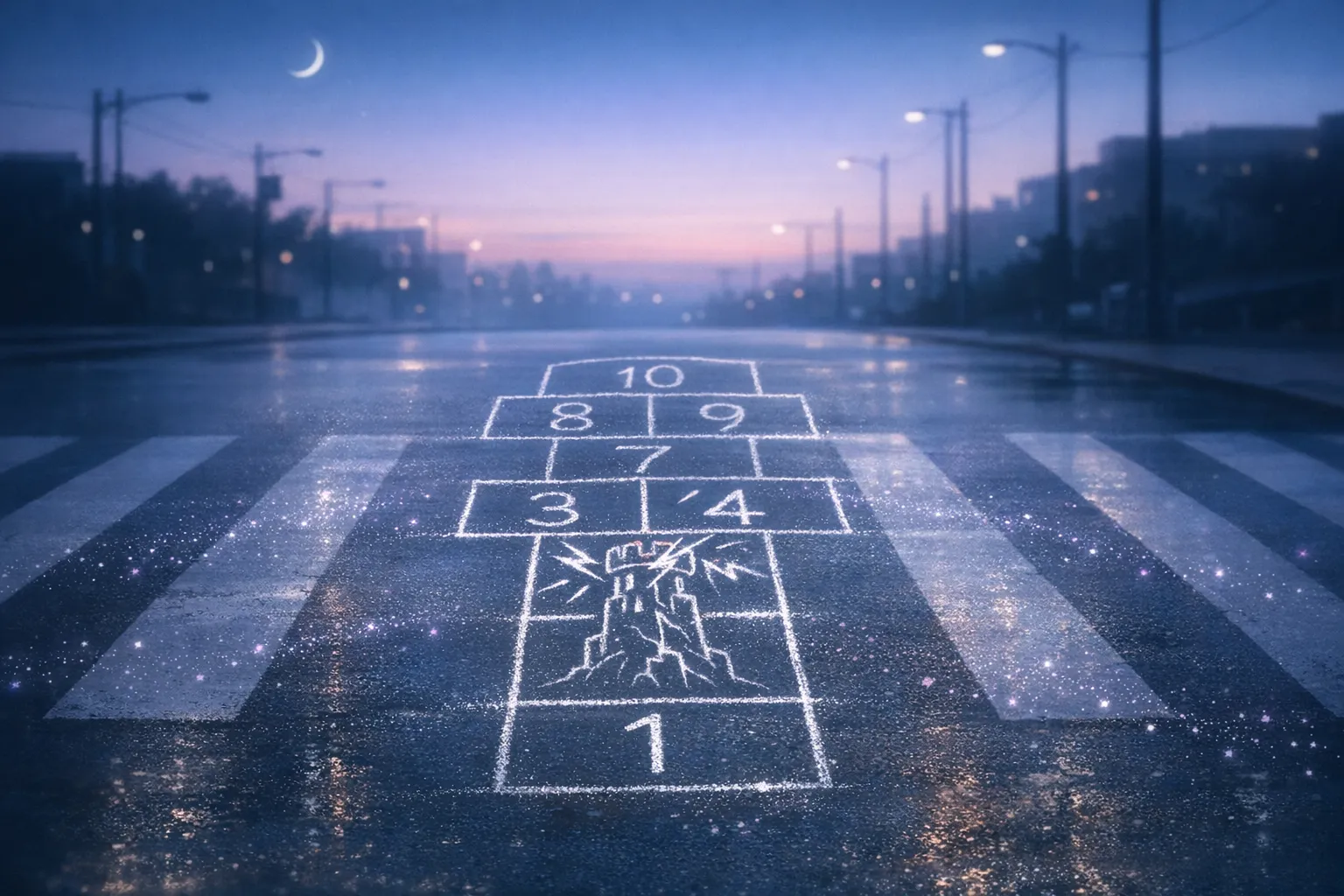
Evening fog combs the city into soft focus, and the lights on the crosswalk blink like patient constellations, ferrying us from one shore of the street to the other. I pause at the curb with traffic humming like a low incantation, and a scatter of glittery chalk dust catches the glow – stardust trails pressed into asphalt. There’s a child’s hopscotch grid scrawled right across the zebra stripes, numbers leaning into each other like tipsy planets. My foot hovers over the first square, and the air feels suddenly tender, as if the sky has leaned down to whisper, “Choose.”
Eclipse season lingers like an eclipse always does after it passes – shadowy fingerprints on the day, brightness with a memory. Astrologers call eclipses turning points, unseen hands on the dimmer switch of fate. I think of them more as doorbells: the ring that says someone on the other side wants to speak. In the streets, that someone speaks in chalk smudges, lost feathers, and parking tickets that land right when you finally forgive yourself for being late. Crosswalks – literal intersections – become cosmic crossroads, the kind Hekate might have once wandered if she carried a reusable coffee cup.
When I step out, tires sigh on wet pavement, and I imagine the lanes as planetary orbits. Pedestrians, all of us, are tiny wandering stars. The chalk hopscotch becomes a map I didn’t know I needed, nine boxes for the nine times I nearly said no to change. I take the first hop, a tiny leap of faith. Eclipse energy has that nudge – move, but pay attention. Don’t run the red. Read your omens out loud. If a pigeon lands exactly on the number seven, maybe Saturn’s having his say. If a green light hesitates, maybe the Moon’s caught in the hedge.
The ordinary blooms strange and lovely when I let it. The city becomes a deck of cards, faces up: bus schedules, candy wrappers, a sticker that says Begin Again. At a crosswalk, choice is condensed into one clean breath. Step now, or wait. Listen to the hum of engines, the hush of your own pulse, and the faint, starry giggle of chalk dust brightening your shoes.
Chalk Symbols and Eclipse Revelations
Chalk is a humble oracle. It crumbles, smears, refuses perfection, and that’s its magic. During eclipse season, I watch for chalk the way sailors watch for wind ripples on water. A spiral means the day is coiling toward a center; an arrow, that something wants direction; a heart, that tenderness has a message but may arrive with scuffed knees. Even hopscotch grids become lunar calendars: ten steps toward a reset, jump on the new square, land on the old one with a laugh.
Eclipses stitch shadow and glare together. They’re not here to scare us; they’re here to change our eyes. I once saw a crescent drawn in pale blue chalk, thick on one side, thinning to a whisper, and realized it mirrored my own energy – full in the morning, evaporating by noon. I moved a meeting. Later that day, a sudden invitation yanked me into an alleyway art fair I never would have found otherwise; a painter’s sky was filled with silver dust that looked exactly like the chalk crescent, and I felt as though the Moon had winked.
A quick pocket definition, because people ask: when we say “retrograde,” we mean the way a planet appears to drift backward from Earth’s point of view, like a commuter missing their exit and circling back around. Eclipses aren’t retrogrades, but they flirt with the same rule-bending mood. Time zigzags. Memory speaks in subtitles. Chalk drawings left by strangers become coded postcards from your future self: turn here, call them back, let it end, let it start.
I like to watch how rain edits chalk. What it chooses to blur might be what I can release; what it leaves crisp may be what I should carry forward. Yesterday’s cloudburst erased everything but a bright little star drawn in yellow. A stardust trail of powder led from it to the curb, where a single coin glinted. I’m not saying fate pays in pocket change, but I am saying that coins can be circular yeses. The eclipse asked a question; the star answered with shine.
Chalk isn’t permanent. Neither are most of our turning points. But they mark us the way a finger traces fog on a window: briefly, clearly, beautifully enough to see what we were about to miss.
Unexpected Synchronicities: From Tarot Cards to Street Signs
Cartomancy – reading cards – serves me best in public places, where the city’s heartbeat can shuffle my thoughts. Once, I drew the Tower in a park – a card of shock and revelation, the lightning that rebuilds by breaking. I flinched, of course, because who doesn’t brace at falling stones? Then I stepped out, and there it was: a hopscotch labyrinth chalked on a crosswalk, numbers scattered like sudden rain. I heard it, not in words but in the prickle along my arms: expect toppled routines, but keep it playful. The Tower, yes – but with sneakers and laughter.
That’s the way synchronicity works for me. The card opens a door, and the street sends a messenger. A speeding bike’s bell becomes a punctuation mark – exclamation, warning, thrill. A street sign turns odd: Detour looping back to the very block you meant to avoid. A billboard lyric – something about “falling into place” – arrives exactly when you’re counting how many things are falling apart. Eclipse season adds a phosphorescent edge to it all, highlighting the footnotes you used to skip.
When I’m wary of reading too much into coincidence, I bargain with fate. “Three times means listen.” Then I pull the same suit twice – say, cups, the realm of feelings – and the third echo appears as a puddle reflecting a sliver of mid-day moon. That’s my chorus. I don’t treat it as law, but I give it the courtesy of attention. Attention is the most faithful altar I know.
Let’s keep it simple, because busy streets don’t wait:
- If your card of the day and your street sign share a theme – change, rest, courage – let it color your next small choice.
- If your draw feels heavy, scan the sidewalk. Look for one light detail to carry as a talisman: a chalk star, a bright leaf, a sticker with an odd word.
- If nothing lines up, that’s guidance too. Some days want you present, not prophetic.
Back at the curb, I still think of the Tower paired with hopscotch. It changes the story: Maybe the lightning strikes the boxes, not the person. The pattern shakes loose, and you land on a new square laughing because the world didn’t end; it shifted a lane, and the light changed just in time.
Eclipse-Season Timing: When the Street Speaks Loudest
There’s timing to this dance, a rhythm stitched through with lunar thread. The days around eclipses feel like the city has inhaled and forgotten to exhale. Lights seem to blink slower, or maybe it’s just my attention finally practicing a deeper kind of seeing. If you lean in then, the smallest omen reverberates. A chalk arrow pointing to a café chair leads to a conversation you needed. A traffic light glitches, and you catch the bus you would have missed. It isn’t that fate is stage-managing, more that your feet and the pavement agree to be in step.
I keep loose time with moon phases: the dark swath around a new moon is a corridor – listen there, especially at crosswalks that feel oddly hushed. First quarter is for experiments: hop the grid even if you’re wearing boots. Full moon, of course, amplifies everything. Eclipses knot themselves into these cycles like glitter in hair; you find them long after the party. If you can’t sleep, walk the block and see what chalk has to say. Even a faint line becomes bright under a streetlamp, like a stardust trail gathering its courage.
Cartomancy joins the chorus by offering tempo. A sword card says quick cuts; wands spark movement; cups linger; pentacles ground. If the cards go earthy on an eclipse-tilted day, I’ll make my questions practical: Which route? Which step? If they blaze fire, I’ll watch for literal sparks – skateboard wheels striking, a dry leaf skittering into traffic and surviving the shuffle.
This isn’t recipe work; it’s listening. But there’s a tiny ritual I borrow from the streetlights themselves:
- Before crossing, ask your question quietly.
- Watch the light, but also the corners of the scene: chalk edges, pigeon choreography, the way the wind pushes a receipt toward or away from your shoe.
- Step when it feels like breath and signal agree. If you catch a fragment of a song from a car window that answers you, grin. That’s the city tipping its hat.
Eclipse season is not a time to force outcomes, but to agree to be found. I promise the omens are trying to be obvious; the trick is to become a softer surface for them to land on.
Street-Side Cartomancy: Reading on the Move
Tarot spreads don’t always need a table; sometimes your palms are the table, your knees the altar, your coat pocket the velvet bag. I like to pull one card as I wait for the walk signal, eyes up, ears tuned to the fizz and hush of the street. If it’s the High Priestess, I practice silence for a block. If it’s the Fool, I let myself take a new route without announcing it to my anxiety. Moving readings are tender things; they prefer how you listen over how much you know.
The cards and the asphalt collaborate in delightful, improbable ways. Draw the Chariot, and you might notice a delivery driver’s grin, a metaphor for willpower and wheels. Draw Temperance and watch two strangers share an umbrella – an alchemy of kindness. Eclipses add intensity. If the Moon card appears around then, my senses ripple: reflections, echoes, double-takes. I don’t seek mystery so much as let it sit in the passenger seat, narrating softly.
The best part is that the city supplies clarifiers. If a pull feels muddy, I let the next block speak. Once, I drew the Lovers and snorted because I’d just argued with my own schedule. Then I passed two chalk figures drawn hand-in-hand, and felt the sharp little click of recognition: choose with devotion, even if the beloved is your Tuesday.
Skeptics pass by with earbuds, which is fair. This isn’t about proof. It’s about intimacy with the moment. Like catching sight of a stardust trail where the sun hits a cyclist’s sleeve and understanding that beauty alone can be instruction: slow down long enough to notice it, and your choices start to taste like they belong to you.
If you want a pocket practice without fuss, try this: one card at the curb, one intention in the breath, one symbol from the street to carry in your pocket or memory. Retire the symbol at day’s end by washing your hands and thanking the sidewalks. The city holds a million tiny altars; you just happen to be one of them, walking.
Glitter Spells and the Art of Noticing
Sometimes it really is glitter. The kind that lingers despite every sweep of your hand, the way cosmic timing lingers after an eclipse, sparkling in the periphery. I’ve seen sidewalks turn into galaxies with a single handful of party confetti pressed into damp chalk. You don’t need to own those moments to be moved by them; you just have to be willing to let them rearrange your interior furniture an inch or two.
Glitter spells are simply agreements with delight. When eclipse season presses its thumb on the scale of coincidence, these little flashes carry extra voltage. A glitter-dusted hopscotch feels like a dare issued by the cosmos: lighten up while you leap. The Tower might tumble your schedule, but what if the rubble shines? What if every toppled plan throws back a starlit echo, pointing at the space you didn’t know you wanted to build?
I like to imagine chalk drawings as temporary constellations. The line between a cat doodle and a dragon becomes a myth about how you approach the unknown. Street signs join, patient and deadpan: Yield, they say, and then, Play Street. During the last eclipse corridor, I watched a bicyclist trace a lazy S across the lane, and a gust scattered chalk dust into a soft comet tail. I took it as permission to slalom through my to-do list – not to avoid, but to dance.
Some people take these winks as marching orders. I prefer them as companions. If I find myself pushing too hard, I ask one more question of the curb. The third act belongs to the streets anyway: I’ve learned more from a smeared arrow than from a hundred tidy plans. And when the sky wants to be specific, it will. You’ll turn a corner and see your thought written in pink dust, or you’ll overhear the precise sentence you needed. If you want a nudge that carries your name, a gentle psychic reading can braid your symbols into a story; but even then, the city will edit with its own punctuation marks – pigeons, sirens, sudden glitter.
The art of noticing is the only wand that never runs out. Keep your gaze soft. Let your footprints be a kind of listening. And when you come to a crosswalk sequined with chalk, try one hop. The universe likes a participant. The stardust likes a shoe.

