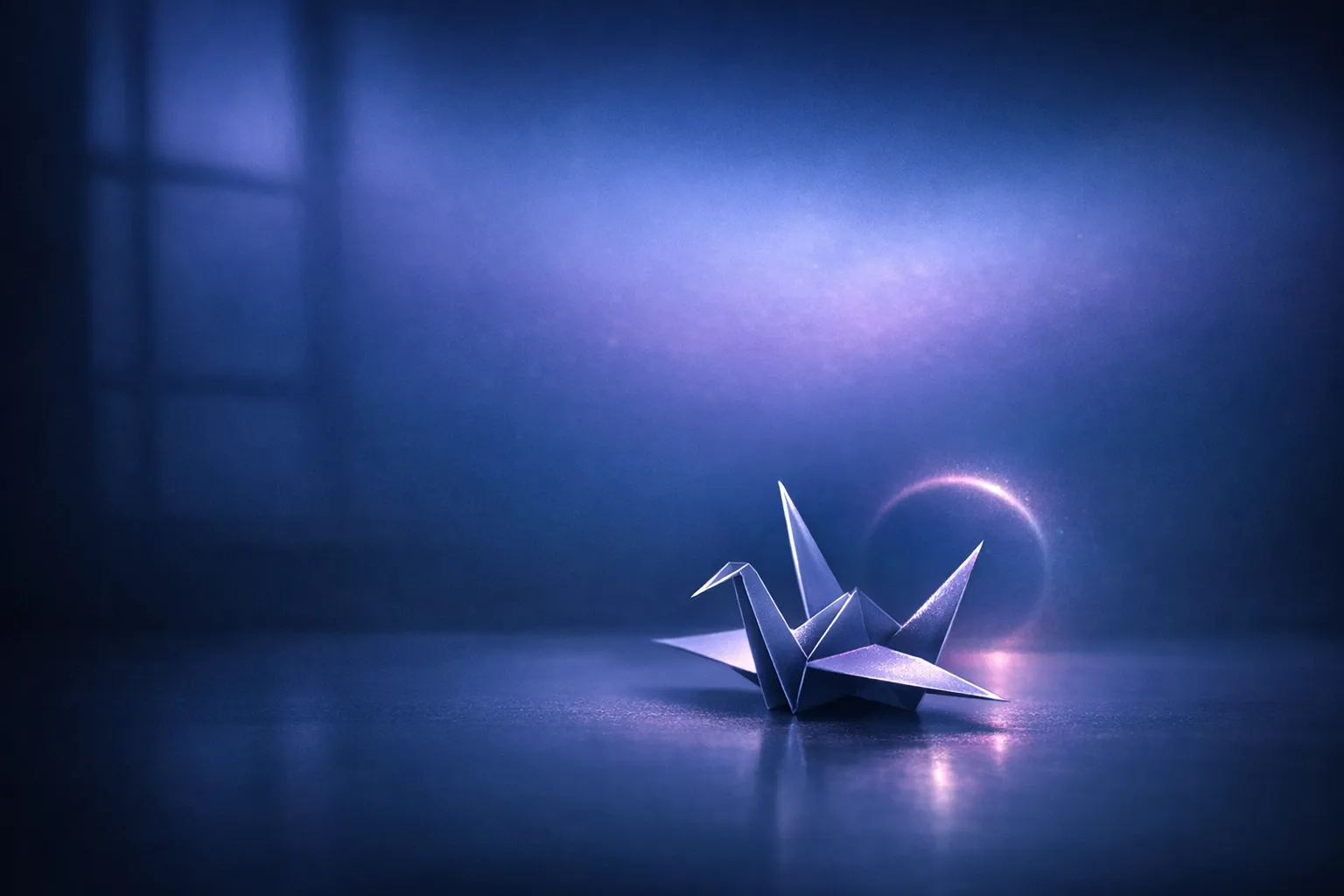
Unfolding the Wings of Bravery
Midnight hums like a held breath. You sit on the soft geography of your bedroom floor, paper balanced on your knees, the world reduced to a quiet crease and a pulse in your fingers. Outside, an eclipse slyly tucks the familiar moon into shadow, and the sky feels like a stage-change: lights dim, curtain shifting, new act arriving. This is where you begin – one square of paper, one steady inhale, one crease that says, “I’m here. I’m ready.”
Eclipses mark thresholds. In astrology’s gentle language, they’re the hush between heartbeats when old scripts loosen their grip and you sense the paper winds of change ruffling your edges. You don’t have to be an expert; you just have to be present. Courage doesn’t roar tonight – it rustles, like origami waiting to happen. You hold the square and picture your name written on it in invisible ink, traveling line by line into a shape that remembers how to lift.
You might think bravery arrives with trumpets. Tonight, it arrives with two hands and a fold. Each crisp line is a vow. You align corner to corner and feel the slight resistance of the page, the way fear also resists – and then yields once given a direction. The paper is not precious; the intention is. This is your midnight apprenticeship with change.
Imagine your courage as a filament threaded through the sheet, stitched along each edge. When you fold the first triangle, you bury the jittery what-ifs. When you reverse-fold the beak, you sharpen your voice. As wings take form, you’re giving fear a structure that can fly rather than a room to echo. Eclipse hours nudge you to reassign your energy: less to rehearsing dread, more to rehearsing flight. Tonight, bravery is not an outcome; it’s a technique – crease, smooth, breathe, repeat – until the thin page holds a secret architecture of yes.
The Symbol of the Crane: Graceful Strength
Cranes don’t rush; they consider. Across many cultures, these long-legged birds are emblems of longevity, devotion, and a quiet sort of power – the kind that shows up without fanfare and keeps showing up, season after season. In Japanese tradition, a thousand cranes are said to grant a wish or long life, not because a genie appears, but because repetition sculpts the soul. Fold enough patience into your hands, and perseverance starts to feel natural.
Think of the crane’s posture: tall but not rigid, wings that can skim fog and sunlight alike. It’s endurance with elegance, the soft insistence of the river that still reaches the sea. In myths, cranes are messengers that bridge worlds – the everyday field and the bright altitude above it – reminding you that your ground-bound routine and your sky-bright dreams are not in conflict. They simply need a hinge, a pivot, a fold.
When life feels like a wind tunnel, the crane’s medicine is poise. It says, Balance first, then rise. The beak is your clarity, the wings are your boundaries, the tail your steady center. Even their migrations read like a map of returning to what matters. You don’t need to become someone else to be brave; you need to become more like the crane you already carry: patient spine, watchful eye, unstartled by small storms.
There’s a reason your midnight paper wants this particular shape. The crane is a portable altar for resilience – minimal, pocket-sized, humble. Each crease is a decision to travel light. And the bird’s final form carries an invitation: Let your courage be kind. Be the sort of strong that doesn’t trample the grass, but still leaves footprints the dew can find at dawn. When you set a crane on your windowsill, you’re leaving yourself a map for calm ascent, a silhouette that whispers, There is more sky than fear.
Midnight Ritual: Folding with the Moon
Eclipse nights feel like a page turning itself. Astrologically, an eclipse is a temporary tangle of Sun, Moon, and Earth that blinks the light and shifts perspective. It’s an edit in the manuscript of your habits, an invitation to release a plotline you’ve outgrown. At midnight – when the clock draws a thin silver line between before and after – you become the author with a square of paper for a pen.
Prepare a small nest of intention. Dim the room so the night feels close, but keep a friendly lamp or candle for your work. Set a glass of water nearby; sip between folds as if you’re hydrating your bravery. Choose a square of paper that pleases your eyes – plain white for clarity, blue for composure, red for heart, gold for a little boldness. If you like, write a single word on the inside before you begin: Steady. Speak. Cross. Rise. This is the thread that will run invisibly through your bird.
Now fold. Let your breath mark the steps:
- Fold the square corner to corner into a triangle. Smooth the ridge with your thumb. That ridge is a spine; imagine yours aligning.
- Open it, then fold the other diagonal. Two paths intersect, a compass for your courage.
- Flip, fold side to side into a rectangle, open, then the other side. You’ve sketched a grid of possibility.
- Collapse into the preliminary base (bring the sides inward along the creases). It’s the first small surrender to structure – fear loosens when given form.
- Lift one flap, fold its edges to the center line. Repeat on all sides. Precision invites peace.
- Reverse-fold the head and tail. Decide which end will speak for you; give it a beak.
- Open the wings. Breathe – a quiet unveiling.
As you crease, picture the paper winds of change sweeping gently through your room, lifting the corners of your thoughts. You’re not bargaining with the sky; you’re syncing with its rhythm. When you finish, hold the crane over your heart. Whisper a sentence of permission: I allow courage to move through me. Place the bird where the eclipse light, or tomorrow’s sunrise, can find it. If a tremor of doubt returns, tap the wingtip with a fingertip – the way one might reassure a friend – and remember how quickly a flat sheet learned to fly.
Mini-Break: Myth vs. Reality – Eclipse Edition
- Myth: Eclipses cause bad luck, so rituals are risky. Reality: In symbolic practice, eclipses highlight change. They’re not doom, just high tide. You’re surfing, not summoning trouble.
- Myth: You must fold exactly 1,000 cranes to see any effect. Reality: One mindful crane can shift your inner weather. Repetition deepens the groove, but meaning lives in attention, not math.
- Myth: Only perfect folds “work.” Reality: Wobbly wings still remember the sky. Imperfect bravery is still bravery.
- Myth: You need rare paper and a complex altar. Reality: A scrap from a notebook and your steady breath can be a sanctuary. Intent is the lantern; tools are optional.
The Paper Winds of Change: Timing, Omens, and Ongoing Courage
Courage is a frequency you can tune like a late-night radio. The eclipse opens the channel, but you can return to it. Think of your cranes as dial markers – small, bright notches noting when you reached for your own hand and squeezed. Some nights the signal is crisp; other nights, static. Keep folding anyway. Over time, your room becomes a sky of tiny mentors, each one reminding you of a specific promise you kept to yourself.
Timing adds texture. If the eclipse is solar (New Moon meeting the Sun), it’s a threshold for beginnings – fold cranes to step forward: new conversations, applications, first drafts. If it’s lunar (Full Moon momentarily dimmed), it leans toward closures and honest releases – fold cranes to set down a pattern, to end the sheepish pause before you hit send. Retrograde, that astrology word that simply means a planet appears to move backward from our view, can feel like life rewinding. During retrogrades, let your cranes review scripts, patch small tears, and reinforce your patience. You’re not retreating; you’re refolding a crease so the wings open cleanly later.
You can also enlist omens with a light touch. If the night offers a wind gust while you fold, consider it breath from the bigger world. If the house is still and your paper crackles loudly, maybe that’s your own static clearing out. A song drifts in from somewhere with a lyric that pins your situation? Tuck a snippet of it under your crane’s base. Let everyday life collaborate; courage loves co-authors.
For a continuing practice, try this brief rhythm:
- Choose a word before midnight.
- Fold a crane with that word inside.
- Place it somewhere your future self will accidentally find – coat pocket, book spine, plant pot.
- When it resurfaces, act within 24 hours on one small brave thing aligned with the word. This small loop builds a muscle that outlives the headline event of the eclipse. You’re teaching your hands to answer fear with form, your breath to lengthen the moment before you decide. And if you want a nudge or a mirror, you can explore a psychic reading to pick up threads you might be missing, then return to your paper flock with fresh clarity.
Before sleep steals the room, look at the cranes you’ve made – their beaks patient, their wings mid-idea. You haven’t banished fear; you’ve given it a vehicle. In the hush after midnight, let them remind you that even shadows serve the light, that even thin paper can learn the myth of lift. And when morning pries open the blinds and spills onto your floor, notice how your courage lands differently in the body – quieter, steadier, already shaped. Keep a square in your bag. Keep a promise in your palm. When the next wind rises, you’ll already know which way to fold.

