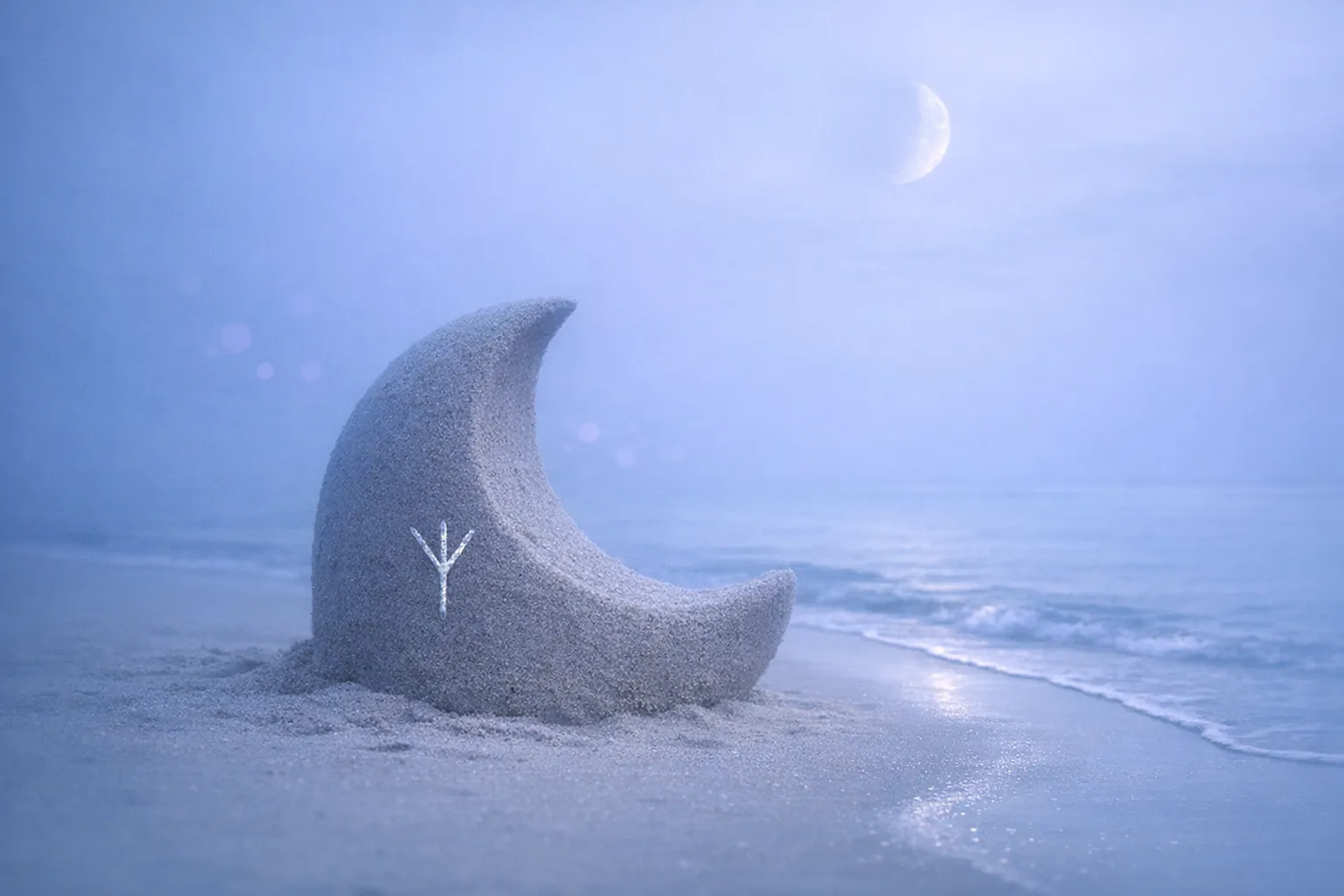
When Sandcastles Speak
Dusk leans lavender over the water, and the beach holds its breath. A gull scribbles a question mark across the sky; the tide answers in parentheses. On the tideline: a little city of crenellations and moons, spires pointing at nothing in particular and yet somehow at you. It’s here, ankle-deep in foam, that we do our best myth-busting. The moon doesn’t tug your mood like a string on a kite – at least not in any lab-coated way – but symbols have always tugged our attention, and attention is where magic begins. So we keep walking, we keep noticing.
Let’s retire the idea that quarter moons are weak sauce compared to the drama of full moons. Quarter moons are turning points – the pivot in the celestial hinge. The first quarter is the build, the second quarter (often called the last quarter) is the edit. If a full moon is a spotlight, quarter moons are the quiet click of a new slide. On the beach, that means you’re more likely to spot “in-between” sculptures: half-formed forts, crescent walls, a moat that’s clearly mid-plan. The universe isn’t yelling; it’s nudging.
I like to talk to beachgoers – quick chats, sandy toes, salt on our lips. A teen with a bucket tells me, “I only make half a castle. I like the idea it could still grow.” Quarter-moon energy in a nutshell. A retired art teacher confides that she knocks down a turret on purpose at the last quarter: “It helps me see what I don’t need.” That’s the moon’s quarter-breath, translated into sand. We don’t need precision instruments to measure it; the point is the conversation between what we build and what we let the tide revise.
So when sandcastles speak, they don’t predict stock prices. They prompt better questions. Why this shape? Why now? Why did you stop stacking towers at three and wander off to draw a simple crescent in the wet sand, right as the moon’s own crescent hangs like a silver ear listening? The tide is fluent in hints. We listen by noticing.
Quarter-Moon Phases and Beach Walks
Let’s unpack the rhythm without the superstition suit of armor. “Quarter moon” isn’t a half-lit pie; it’s the name for when the sun and moon form a right angle from Earth’s view, tension in the geometry, crisp and productive. At the first quarter, we’re asked to commit: keep building this sand city or pivot to a seashell mosaic? At the last quarter, we’re invited to release: smooth the sharp edges, dismantle the bridge that never reached the water, recycle the wall into a spiral.
Debunk corner, tide edition:
- No, the quarter moon isn’t a moody cousin of the full moon with nothing to offer. It’s the hinge on which the fortnight turns.
- No, you’re not “supposed” to feel a certain way. Symbols don’t boss you; they suggest choreography.
- And no, a castle collapsing during a quarter moon isn’t bad luck – it’s feedback from gravity and a lesson in foundations.
Now, lace your beach walk to the lunar metronome. At first quarter, the horizon looks like a to-do list. You notice designs that want extending: a crescent wall that begs to become a full ring, a half-stair that desires the next step. This is the time to add one bucket more. Imagine spotting a perfectly formed sandcastle in the shape of a crescent moon during an evening beach walk at the first quarter moon – it's no coincidence, but a call to explore opportunities. Not destiny – direction. The quarter moon challenges you the way wet sand challenges your sculpting hand: press too hard and it slumps; press too light and it crumbles; find the pressure that holds.
At the last quarter, your walk tastes tidier. You catch yourself smoothing, curating, turning a chaotic drip castle into a sleek, wind-carved dune shape. A kite flyer tells me she cuts her string shorter at this phase: “It’s how I keep the sky from tangling me.” On the sand, that looks like trimming extra turrets, leaving a single proud arch, or sketching tide lines as if they were margin notes. The art is in the revision.
The myth to release is that moon-watching makes you passive. Actually, it makes you choosy. The quarter moon doesn’t declare fate; it offers a drafting table. Your footprints are the footnotes.
Runes in the Sand: Symbols or Just a Game?
Enter the runes – not as relics with strict rules, but as alphabetic pebbles of meaning, ready to be borrowed by anyone with a pocket and a question. A rune is a symbol from old Germanic alphabets, each with a name and a vibe: Fehu whispers about resources, Algiz throws up protective antlers, Tiwaz is the pointy spear of courage and direction. Place them in the sand and they look less like commandments and more like seashell graffiti with a message.
We myth-bust gently here: runes are not magic coins you feed into fate for guaranteed outcomes. They’re mirrors held at angles. The beach, with its vast white page, invites a conversation between letter and landscape. I once watched a little kid draw a big, jagged zigzag in a sand circle – accidental Sowilo, the sun rune – and then crown it with a crab shell. “It’s the sun with armor,” they declared. That’s the point: interpretation that goes beyond the textbook and into the tide.
Imagine you stumble upon a sandcastle shaped like a dragon, all scales and snout, and next to it lies a palm-worn stone scratched with Uruz, the rune of primal strength and life-force. A sandcastle shaped like a dragon paired with a rune stone of strength suggests that something mighty is at play in your life. Not a monster to slay – more like the raw push to grow a new rib of courage. Or maybe you see a delicate bridge that almost touches another, and beside it, Gebo – the “gift” rune, an X like two paths crossing. Cue the nudge to collaborate, to meet halfway, to trade shells instead of hoarding them.
Skeptics often ask, “Isn’t this just pattern-finding?” Yes, and that’s the lovely engine of symbolism. Patterns are how the brain sings to itself. What matters is the quality of the song: Are you humming dread or adventure? The beach gives you drafts; the rune gives you a title. You’re the editor.
And because clarity prefers play, consider a single-throw approach: pick up whatever small shell your hand finds first, draw one rune in the damp sand, and place the shell atop it like a crown. Step back. What does the tide erase first – the line or the letter? That’s a conversation about timing right there.
Pocket Moon Maps In Sandcastles
Let’s stitch it together: quarter moons as pivots, sandcastles as sketches, runes as captions. Call it a pocket map you draw, erase, redraw, and fold into your evening. No need to make it heavy; the tide likes light hands.
Interview snippets from the shoreline chorus come back to me:
- The surfer who says he shapes his wax at first quarter: “I commit to the line I’ll carve.”
- The librarian who rakes a zen garden into the beach at last quarter: “I keep the poem and release the fluff.”
- The kid who taps each turret thrice and whispers “Fehu, Fehu, Fehu,” then shares her shovel with a stranger. Resource becomes generosity. That’s beach math.
If you want a playful check-in during the moon’s quarters, try this quick rhythm:
- Look: On your walk, pick the first castle or sculpture that catches your breath. Don’t shop around.
- Name: Pull or draw one rune and give the whole scene a title – “Bridge Gift” or “Dragon Strength” or “Quiet Antlers.”
- Move: Add one gesture only – one more bucket, one smoothed wall, one shell placed just so. First quarter? Add. Last quarter? Edit.
- Leave: Step away and let the tide co-author. Your willingness to be revised is the wisdom.
The myth we’re done with: that omens come only from rare herons landing in slow motion under eclipses. Meanwhile, the universe is winking from a lopsided moat. The message isn’t “Beware Tuesday.” It’s “Notice the nudge.” When you notice, your choices get friendlier. You aim the spear where it belongs, you accept the gift that’s already been placed in your palm, you trust that even a half-built wall has information about balance and pressure.
If questions remain – about timing, about the next step, about whether your dragon is a guardian or a mirror – that’s not failure. That’s the honest tide of curiosity, the kind that pairs beautifully with a quiet spread of symbols or a thoughtfully guided psychic reading where the beach becomes a stage for your own voice to echo back, clearer.
Mini-break: Myth vs. Reality, Tidal Edition
- Myth: The moon phase causes your castle to fail.
- Reality: Sand-to-water ratio, foundation depth, and human attention do the heavy lifting. The moon simply sets a mood for how you read the moment.
- Myth: Runes “decide” for you.
- Reality: You decide; the rune helps you hear the part of yourself that already knew.
- Myth: You must decode the “correct” message.
- Reality: You’re crafting a meaningful one. If it stirs wisdom and doesn’t harm, it’s doing its job.
Walk home with salt in your cuffs and one small answer: what to add, what to ease, what to crown. Pocket your map even if it’s just a word. The tide will rewrite; you’ll write again. That’s the secret choreography of sand and moon – tidal secrets turning your feet into compasses, your castles into conversations, your summer into a series of shimmering edits and brave, bright starts.

