The Magic of Thresholds
Surprising fact to tuck behind your ear: the ancient Romans gave doorways their own deity – Janus, keeper of beginnings and endings, who faced both ways at once. They knew what we sometimes forget: thresholds are tiny portals where reality loosens a notch. At the new moon, when the night sky looks like an unblinking ink drop and the lunar tides in our bodies go quiet, those portals hum. The house exhales. The wind grows opinionated. And ordinary doorways, side gates, and garden arches begin to behave like discreet oracles with a flair for metaphor.
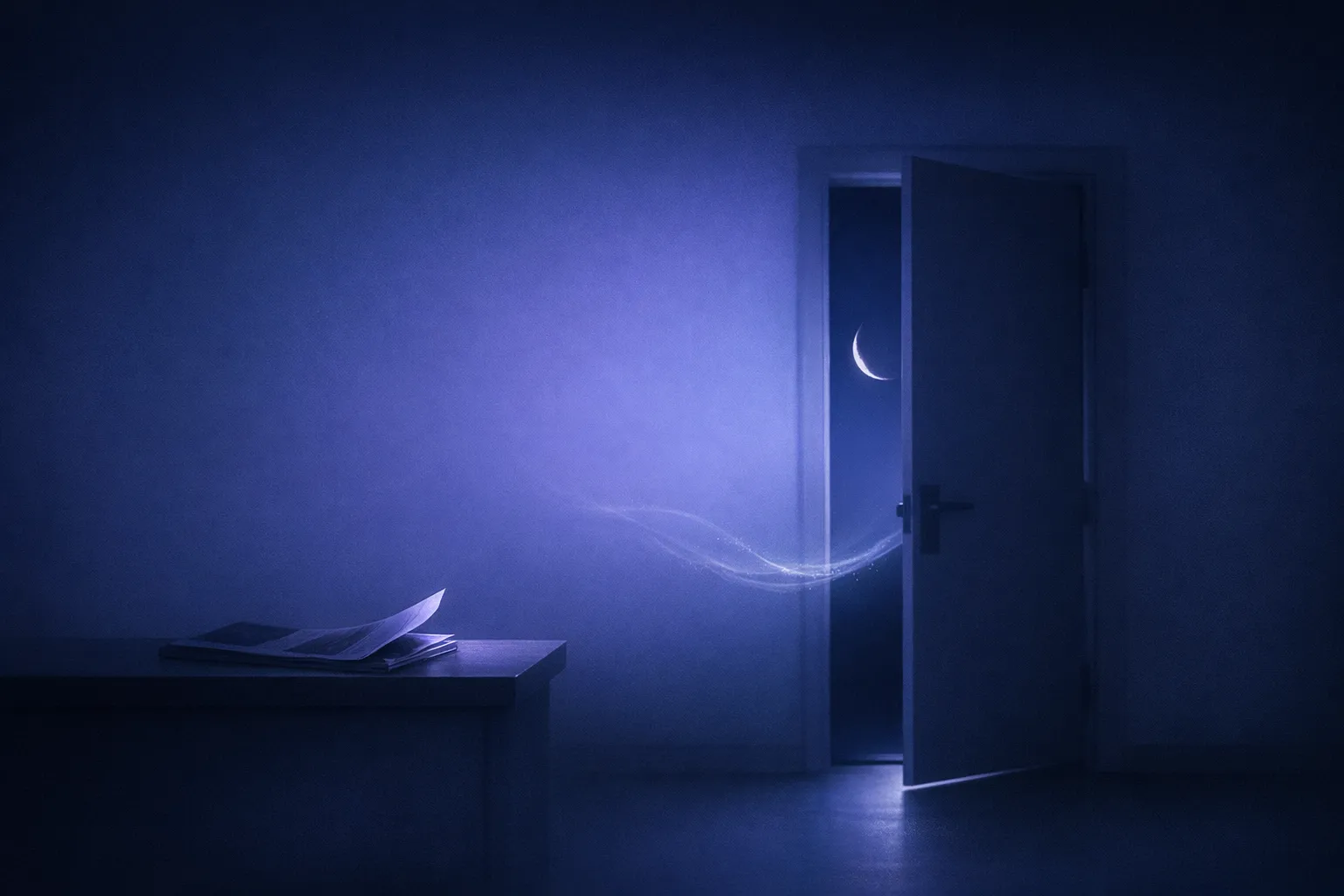
Imagine it: you, in sock feet, a side-door cracked open, the kitchen lamp painting a soft circle of gold, and a breeze that flips an old magazine to an article you didn’t know you needed. The page rustles like a leaf whispering gossip with the moon. Not a thunderbolt of fate – just an everyday omen with good manners. New moons are not about blaring announcements; they’re about invitations. The dark lunar bowl says, “Place a wish here,” and the thresholds of your life – literal and figurative – answer, “And notice what crosses.”
I’ve asked people about their threshold moments. A barista told me the first ivy leaf finally slipped under her apartment door the night she decided to leave a job; she took it as the green light to grow elsewhere. A retiree said the hallway motion sensor blinked on each time he spoke aloud a plan for his next chapter; he treated the lights as applause. A teenager kept hearing the gate latch click right before messages from a long-distance friend arrived, as if the yard itself leaned in to say, “Incoming.” Maybe it was wind. Maybe it was wiring. Maybe the house was simply nosy. The point is not engineering; it’s conversation.
New moon magic is the art of overhearing the world. You set your intention in the hush and then eavesdrop at the edges where inside meets outside. Side-doors, kitchen pass-throughs, the space between porch and night – these are the postal slots of subtle guidance. You’re not begging for omens; you’re flirting with them. Close your eyes, think of the wish you’re planting, and ask the wind to fold you a small postcard from the next version of yourself. When it arrives – on a draft, in a flicker, with a soft rattle – notice. The universe often speaks fluent housekeeping.
Bridging Two Worlds: The Side-Door as a Portal
Let’s put our ear to the hinge and talk technique, because ritual can be a gentle set of manners for invisible conversations. Here’s a scene I love: a side-door that doesn’t see much company except you, the compost bin, and the moon. You sweep its sill the way you’d clear a workbench. Not to make things “pure,” but to show the wind you are paying attention. You place something there that marks your welcome – maybe a small saucer of salt for clarity, or a pebble from a place you felt brave. These are not charms the way cartoons do them. Think of them as punctuation marks for your intuition.
On a new moon evening, stand at the side-door and ask a simple question you can feel in your ribs. Not “Will I be a millionaire next Thursday?” but “What wants to begin if I make room?” Let your breath match the hush outside. A breeze may or may not slip in. If it does, be nosy. Which direction does it come from? Does it lift your hair like a friendly nudge, or skim the floor like a cat slipping by? Does it riffle the to-do list or nudge the postcard on the corkboard? If nothing stirs, that’s information too – sometimes the portal answers with a pause, the way a wise person chews a thought before speaking.
I spoke with a trio of threshold-watchers for a composite conversation. “Nora,” a florist, said her side-door gusts were the best mood ring she owned. If the door sighed inward right as she considered a new bouquet style, she tried it; if the wind shoved hard when she mulled working late, she went home, and the next day a supplier called with a fresher shipment. “Dev,” a city maintenance worker, swears that whenever the hallway draft clicks his keys on the hook, it means, “Don’t forget your ally.” Usually, that means a colleague. Sometimes it’s an attitude. “Mila,” a night-shift nurse, listens for the sound of grocery bags rustling near the threshold. To her, that’s the house saying, “Stock yourself: rest and kindness.”
None of them treat the side-door like a slot machine. They treat it like a pen pal. They write with their attention; the world writes back with motion. The portal is not a loophole in physics; it’s your own awareness learning to translate texture, timing, and a few helpful breezes. That’s the bridge. You don’t have to cross it in robes. Bare feet and curiosity will do.
Share tales of finding hidden meanings in random objects moved by a breeze at these threshold moments.
What do objects say when wind gives them stage time? Listen to the small theater of your threshold. The broom tips over, the spoon winks from the counter, a street leaflet hustles itself under the mat. Because we’re working with symbol rather than spreadsheet, meanings bloom best when they feel obvious to you, even if they’d baffle a committee. Trust your first affectionate guess, then see if the story holds water in real life.
Take the anchor example: the magazine on the kitchen counter, abandoned to life’s churn, rustles open under a backdoor breeze. It lands on an interview about beginners in midlife. You were not thinking “beginner.” You were thinking “How do I keep all these plates spinning without becoming a plate?” The rustle whispers, “Try beginner instead.” That night you pencil five wonky guitar chords. Suddenly a stubborn knot in your week loosens. Coincidence? Of course. But the right coincidence at the right threshold is exactly what a good omen is made of: timing wrapped in texture.
Here are three cameo tales from our composite interviewees:
- Nora once watched a single fern frond slip through the side gap and point toward a crate of out-of-season lilies she’d been guilt-buying. She took the hint and composted the guilt. Sales perked. So did the lilies, in the next life.
- Dev found a hardware-store receipt plastered by draft to the light switch. The total read 11.11, the bulb burned out, and his first thought was, “Upgrade the fixture, upgrade the plan.” He asked for a brighter team briefing the next morning and discovered everyone had been waiting for permission to say what they actually needed.
- Mila keeps an elastic band bowl near the door. On nights she considers overcommitting, a stray gust flips one onto the floor. To her, that’s the snap of boundaries. Sometimes the band breaks. She calls that “confirmation with extra sass.”
Objects don’t boss you; they collaborate. An envelope is not a prophecy. It’s a paper boat sailing your attention to a shore you kind of knew existed. And if the breeze shuffles a deck of junk mail into a neat fan? Maybe it’s not telling you your destiny. Maybe it’s saying, “Even clutter can align when breath moves through.” The omen is less about prediction than permission. Your threshold is a tiny stage. The house lights dim at new moon. When the curtain flutters, applaud, then ask: What wants to begin if I begin it?
The Dance of the Elements: Wind as a Messenger
Let’s invite the wind to introduce itself. In many old stories, wind carries messages because it belongs to both sky and skin. It doesn’t stay put, and neither do ideas. In astrology, air signs – Gemini, Libra, Aquarius – are thought of as the conversationalists of the zodiac: they exchange, translate, connect. You don’t need a birth chart to work with that image. Just picture the breeze as a roving librarian reshelving thoughts, sliding one out of your head and tucking another into your fingers. During the new moon, when the sky curls into stealth mode, the wind’s hush grows noticeable. It’s easier to hear a whisper when the drumline rests.
A quick note on direction, stripped of jargon and kept playful. East-breath tends to feel like sunrise thinking – curious, wordy, beginnings-oriented. South-breath has a peppery warmth: body decisions, appetite, zest. West-breath comes with a rinse of feelings: cleanup, compassion, endings-that-feed-beginnings. North-breath brings the cool spine of resolve: structure, mountain moods, slow magic. If you don’t know where your door faces, let your body translate: does the breeze perk your ears (east), warm your chest (south), soften your belly (west), or straighten your shoulders (north)? That’s the message map. Not a rulebook – more like a scarf thrown playfully over a lamp to tint the light.
Shadows also gossip. A flicker on the floor at the threshold might be your instinct stepping into frame. A shadow that expands and contracts in rhythm could be the breath of the house syncing with yours. If the wind snuffs a candle you meant to keep, don’t read doom; read redirection. Air loves to edit. It trims excess. It says, “This sentence doesn’t need three adjectives.” Ask what the flame was doing for you, and offer that job to a steadier symbol for now – a bowl of water, a smooth stone, a handwritten note.
In our composite chat, Dev said he pays attention to the soundscape. “When the breeze is high and the street hushes, I talk softly to my keys before I lock up. If the jingle lands in one clear note, it’s a green light. If it tangles, I pause and re-ask my plan.” Nora maps textures: silkiness of air equals easy marketing; gritty wind equals hands-in-the-soil tasks. Mila measures temperature on her wrists: cool equals rest; temperate equals social; warm equals body care. None of this would survive a lab test, and that’s fine – threshold practice is poetry, not proof. The goal isn’t to be right; it’s to be in rhythmic conversation with the moving, thinking atmosphere that already knows your name.
Offer a playful narrative on how one might interpret the direction of a breeze or the flicker of shadows as signs.
Let’s string this into a one-night ritual you can improvise like jazz. The setting: your side-door or back entry, that in‑between space where shoes gossip and stars eavesdrop. The moon is dark, a velvet witness. You have a modest toolkit: a glass of water, a piece of paper, something that writes, and one object that means “Yes, I’m beginning.” Could be a seed, a subway card, a blank tag, a spare button. Keep it simple; wind prefers unfussy company.
Step into the doorway and stand so one foot is in and one foot is out. This is you, practicing Janus without the marble. Close your eyes and imagine your intention as a single leaf with your wish inked on it. Now breathe the way leaves do: receive, release, no drama. When you feel the hush settle, ask the air to move if it has a message for now. If a breeze arrives, note the direction as a flavor, not a compass.
- If the air strokes your forehead or the corners of your eyes, call it east-flavored. Whisper a name for the story you’re ready to tell. Write the title on your paper.
- If it warms your chest or brushes your hands, call it south-flavored. Choose one action that feeds your vitality. Write the verb.
- If it swirls at your belly or behind your knees, that’s west-flavored. Name an old emotion that can become compost. Draw a spiral and feed it the word.
- If it taps your shoulders or ankles like tiny drumsticks, that’s north-flavored. Pick a boundary that helps the beginning hold. Draw a square and write its door.
No breeze? Perfect. Hold the glass of water at the threshold where inside light meets outside night. Watch the surface. Shadows will flicker from passing cars, moth ballet, clouds. See which corner of the water darkens first. Read it with the same flavor logic. The trick is not to pounce on the sign; it’s to greet it the way you greet a friend who knocks softly: aware, amused, receptive.
Now place your chosen object on the sill as a token. Objects are excellent at remembering things for us. Say this, or something you like better: “Begin here, begin kind.” Then blow a very gentle breath across the threshold so that inside air and outside air mingle. That’s your signature. Afterward, do one tiny thing that matches your reading: send the email whose title you wrote, take the vitamin your south-breeze suggested, tear the paper spiral and toss it in the soil of a potted plant, set the square boundary with a note on your fridge. And if you want a little extra validation, schedule a quiet moment for a psychic reading later in the week, not to outsource your knowing, but to hear your own leaves whisper back to you through another set of ears.
Keep the object on the sill for a lunar cycle. If wind moves it, don’t panic. Observe. Direction and timing are the plot; your daily actions are the dialogue. Notice how, over the month, the house develops a personality: a wisecracking doorman, a librarian of drafts, a ballet teacher for shadows. By the next new moon, you’ll have a pocketful of postcard spells and a practiced ear for side-door breezes. And if the magazine flips again? Smile. You’re already reading.

