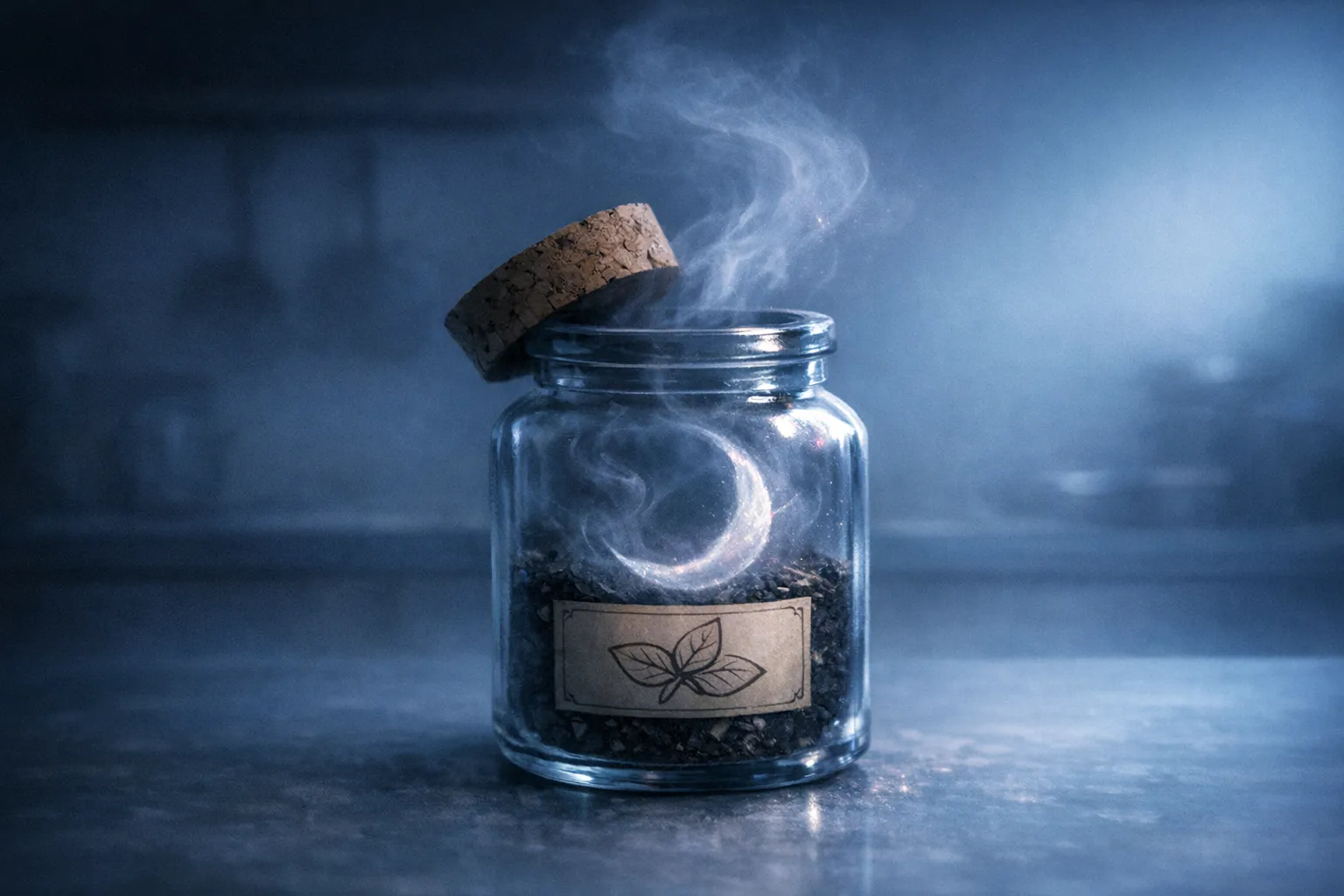
The Spices Whispering: Listen Carefully
The kitchen is quiet except for the kettle’s sigh, and the crescent moon hangs like a clipped fingernail outside the window. I’m rinsing a mug when the spice rack leans into my attention the way a cat leans into a warm patch of floor: not loudly, but with intent. There’s a postcard from the unseen in there somewhere – ink invisible, message traceable by scent, memory, and the soft shuffle of tarot cards. I reach for my deck the way others reach for salt. Shuffle, breathe, listen. Every jar becomes a character in a secret pantry conspiracy, plotting to pass notes to the soul.
Imagine this: you’ve woken from a dream you can almost taste, but not quite name. You’re standing in your kitchen, half between sleep and the day, when your hand drifts toward a jar you hadn’t noticed in months. It’s not logic that steers you; it’s the faint tug of the crescent moon’s intuition, that sliver-light sense that what’s calling is worth hearing. You lift the lid and, like an old friend returning mid-conversation, the fragrance brings the dream back – colors, a hallway, that person you haven’t thought of in years. It’s not the spice doing magic to you; it’s you, catching your own signal by way of an ordinary orchard of jars.
I keep a quick ritual for this kitchen telegraph. I ask, “What is the flavor of this moment?” I draw a single tarot card and then lift the jar that catches my peripheral vision. Not the one I want, not the one I “should.” The one that nudges. The card lays its archetype on the table; the spice lifts its vapors to meet it. Together they make a sentence: The Hermit with paprika might say “Find heat in solitude.” The Lovers with peppercorns could whisper “Commit to the spark.” None of it is proof, all of it is pattern, and the pattern is where the day starts to unfold like dough under warm palms.
Your spice rack remembers what your calendar forgets. It is where your winter soups stored their solace, where summer marinades cheered your ribs into singing, where you corralled the flavors of a year’s worth of turning. The rack is a time capsule and a weathervane. It can’t predict the future in a laboratory way, but it can point toward what your senses already know and your mind hasn’t named. When a jar calls, answer like you would a gentle knock: open, curious, unhurried. Let scent be the guide dog of your intuition. If you need a name for what you’re doing, call it kitchen divination – simple, domestic, and honest as steam rising from a pot.
Nutmeg Dreams and Cinnamon Predictions
Nutmeg doesn’t shout; it hums a low note. Grated into milk or dusted over oatmeal, it turns the air sepia, an instant vintage filter for the morning. There’s an old theater hidden in nutmeg’s warmth – the velvet curtain of nostalgia, the orchestra of memory tuning below the stage. If you sit with it, the aroma will pick up the thread of a dream dropped on the bedroom floor. This is the spice I reach for when a night vision has left impressions rather than scenes: the feeling of running water, the weight of a key, a hallway stretching a little too long. Nutmeg’s fragrance, like a gentle archivist, files the dream under “recognizable” and brings forward what matters.
Try it: when you can’t shake a dream or a question, grate a whisper of nutmeg into warm water or tea. Draw a single tarot card – the Moon if it appears, especially apt – and take a slow breath of the cup before you sip. Nutmeg can coax the subtext out of the steam: patterns from childhood kitchens, the hush of holiday tables, the bittersweet truth that tenderness and fear often live together. Its message often sounds like, “Yes, the past shaped you; now let’s find the door that opens forward.” If you get the Six of Cups, nutmeg nods toward reconciliations; if you draw Death (which in tarot means transformation, not doom), nutmeg warms the shift, saying, “Clear the attic without losing the heirloom.”
Cinnamon, by contrast, walks in like a guardian with a wool scarf. It can taste like a boundary drawn in sugar – firm, friendly, and present. A pinch at the stove and the kitchen smells like safety, the kind that allows curiosity to bloom without fear. Folks have tucked cinnamon sticks into pockets as a protective charm for ages; in symbolic terms, it’s the cord that ties past to future without tangling. When you’re about to send an email that matters, or meet someone whose energy buzzes a little too loud, tip a bit of cinnamon into your morning coffee and let it set the perimeter: clear, warm, yours.
Laid beside tarot, cinnamon behaves a bit like the Chariot or Strength – cards that say, “Harness your direction,” and “Bravery can be gentle.” If you draw the Nine of Wands, cinnamon helps you choose which hill is worth guarding and which gate can finally swing open. Its scent fields off distractions, not by scowling at them, but by sweetly reminding you what you came here to do. Where nutmeg unlocks the dream-drawer, cinnamon secures the pathway once you step out of the bedroom of the subconscious and into the hallway of the day.
The Tarot of Thyme and Basil
Thyme is small, steady, and slightly stubborn. It doesn’t mind time; it practically collects it. If rosemary is your flamboyant aunt and sage your professorial neighbor, thyme is the friend who shows up with a tool kit and a quietly efficient plan. In old kitchens, a sprig of thyme went into stews not just for taste, but for a sense of patience. Symbolically, thyme stretches a thread from past to future and knots it in the present, like touching a bead and remembering the prayer without words. When anxieties braid themselves into a tight rope, thyme untwists them one strand at a time.
If you’re navigating uncertainties that feel like a fogged window – Is this the right project? Is now the time? – shuffle and pull from your tarot deck, then bring your nose close to a jar of thyme. Inhale its green, slightly lemony insistence. Paired with the Two of Pentacles, thyme says, “Balance isn’t juggling; it’s a rhythm.” With Temperance, it becomes the workshop foreman: “Blend, adjust, check again.” Thyme is a quiet clock that asks you to slow decisions until your inner yes clicks into place. Not delay for delay’s sake – delay like dough resting, fibers aligning so the bread can rise.
Basil, on the other hand, is a small festival. Tear it with your fingertips and the room is instantly brighter, like someone lifted the blinds. In kitchens worldwide, basil has been a charm for abundance – not just coins, but also kindness, ideas, and the right people arriving with the right tools. Symbolically, basil is the Ace of Pentacles shaking hands with the Sun. It calls in clarity in practical clothes: a budget that fits and still leaves a little for peaches; a calendar that says yes to the project and no to the spiral; the sudden “Aha” that a cracked window and a different spice pair makes the whole recipe sing.
Consider a simple spread: one card for “What’s sprouting?” and one for “How to tend it?” If you draw the Page of Pentacles and then bring basil to your nose, listen for green-light messages: start the class, send the proposal, repot the plant that outgrew its home (literal or metaphorical). Basil’s clarity isn’t bossy; it’s luminous. It doesn’t demand hustle; it offers direction in bright strokes. Where thyme keeps the clock honest, basil sets the table for what will arrive. Together, they are the pantry’s tarot: one hand on the shoulder to steady you, the other pointing to the open door.
Kitchen Omens Under a Crescent Moon
There’s a special pocket of attention available during the crescent moon – the slim slice of becoming. In astrological shorthand, the crescent shows us intention gathering shape, like dough proofing under a towel. This is a lovely time to ask your kitchen for omens. Not omens as trumpets from the heavens, but as humble signposts: crumbs pointing to the picnic, steam drawing arrows on cool tiles, the way one spice refuses to be ignored. The trick is to stay playful. Omen-hunting turns heavy the moment we grip it too hard.
Picture standing at the rack after a day that braided five conversations, a lost glove, and a sudden idea that won’t stop winking. You shuffle your tarot – small questions, honest breath. You pull the Knight of Cups, the messenger of feeling and invitation, and your hand slides to cardamom even though you didn’t plan chai. Cardamom is the soft diplomat: it opens the room gently so a conversation can step inside without shivering. That could be your omen: soften the approach, infuse the ask with care. Or maybe you draw the Four of Swords – rest, recalibration – and your gaze trips over sage. A pinch in butter, a slow swirl, and the kitchen smells like boundaries whispered rather than shouted. Rest isn’t only a nap; it’s the flavor that says “Enough for now.”
Sometimes the omen arrives as absence. You reach for turmeric but find the jar empty. The missing sun of the spice world becomes its own message: where is the light leaking? Where can brightness be replenished? In symbolic practice, emptiness is a letter too. The pantry conspires with your attention to write it.
If you want structure without stiffness, try this tiny, crescent-friendly sequence:
- Ask your question out loud. Keep it ordinary. “Where is the energy best spent tomorrow?”
- Draw one tarot card. Sit with its picture before the keywords.
- Let your hand hover over the spice rack without looking at labels. Stop where the tug lands.
- Open the jar, inhale, and say the first verb that arises. Stir that verb – literally or figuratively – into your plan.
The point isn’t accuracy; it’s intimacy with your own intuition. After a week of this, patterns peek out: thyme on negotiation days, paprika before a presentation, cinnamon when you need courage that doesn’t clatter. The kitchen becomes a listening booth, and you become the DJ of your own frequencies, fading in what helps, lowering what hisses.
Letters From the Rack: Mini-Cases and Stirred Insights
I promised postcards, so here are a few addressed to particular crossroads, culled from nights when the pantry staged its quiet conspiracies. A friend once wrestled with a job offer that sparkled on paper and dimmed in her bones. She pulled the Seven of Cups – classic vision-clouding card – and then reached blindly for something to cut through the haze. She opened black pepper, and the sneeze-laughter that followed was already a verdict: sharpen, clarify, don’t be dazzled by fog machines. Pepper’s heat punctuated the card’s warning; she asked better questions and discovered the fine print’s bite before it bit her.
Another time, I sat in the lamplight with a relationship question that felt like tuning a radio between stations. The Two of Cups arrived, promising connection if attunement could be found. My hand found vanilla, of all things – steady, soft, often unseen. A few drops into warm milk and the room tilted gentle. Vanilla’s message wasn’t romance fireworks; it was companionship as thermostat: keep warm, keep consistent, keep showing up. Not glamorous, but golden. Two months later, the bond had not turned cinematic, but it had grown real enough to hold two storms without spilling.
There was the morning someone texted in a tangle about creativity gone stale. The Page of Wands popped up – spark seeking tinder – and the rack delivered smoked paprika. Not raw heat, but embered depth. We added a shake to scrambled eggs, and the day took on a campfire’s invitation: tell a story, even a small one. By dusk, a sketchbook page wore six new seedlings of ideas.
If at any point your kitchen augury starts to feel like stretching for messages that aren’t there, that’s your cue to step back, eat something uncomplicated, and let the rack rest. Mystery breathes; it doesn’t perform on demand. Some nights the cards will fly out and the spices will chorus; other nights the only wisdom is that dishes done before bed make morning kinder. Both are omens worth noting.
If you ever want another set of eyes on the patterns you’re seeing – how the tarot cards and flavors weave together, where your questions glow and where they’re asking to be reframed – there’s always the option of a respectful, intuitive companion session, a psychic reading that treats your kitchen, your cards, and your choices as the living story they are. But even without that, you’re fluent. The act of reaching for the jar is already a conversation with the part of you that remembers the path without a map.
Before I close the cabinet, one last postcard: bay leaf. It looks unassuming, slips into soups like a librarian slips into a room, and yet its quiet recalibrates the whole pot. Add one when the question is long-term – mortgages, manuscripts, migrations. Pair it with the Hierophant if tradition needs translating, or the Star when hope needs anchoring. Write your intention on a bay leaf if you like – one sentence only, simplicity is power – then drop it into simmering sauce and let it release the sentence as steam. Later, when you taste the meal, notice how the base notes kept faith with your original wish.
In the end, this practice offers nothing you don’t already carry. The rack only rearranges your attention into a chorus you can hear. The moon keeps its slim counsel over the sink, the kettle sighs, and you – part cook, part oracle – season the day to taste. The message was yours all along; the spices just agreed to pass it forward, one fragrant postcard at a time.

