When the Sky Whispers
Surprising fact to start: in many old sailor logs and monastery records, new moons were kept as “quiet nights” – not because they lacked power, but because they seemed to bend coincidence. Fishermen reported strange bird flights; monks wrote of ink blots forming letters that mirrored their prayers. You don’t have to be a seafarer or a scribe to notice this. On a new moon, your mind becomes a tuning fork. The sky quiets to a velvet hush, and suddenly the world sounds like a starry orchestra testing its instruments: a trill of wind through the grass, the soft percussion of acorns dropping, the string section of crickets holding one bright note. That hush is your invitation to play a game.
You’re not proving anything here – not tracking omens like lab samples. You’re approaching them like you’d approach a magic trick from a dear friend: willing, delighted, curious. A new moon is the monthly reset button in astrology: a slim, dark sky that sets intentions without a spotlight. Think of it as a blank music sheet where your attention writes the first notes. The rule tonight is simple: what catches your senses counts. A rustle that repeats three times, a porch light that flickers when you think of a name, a moth that lands on the page you’re reading – these are instruments stepping up for a solo.
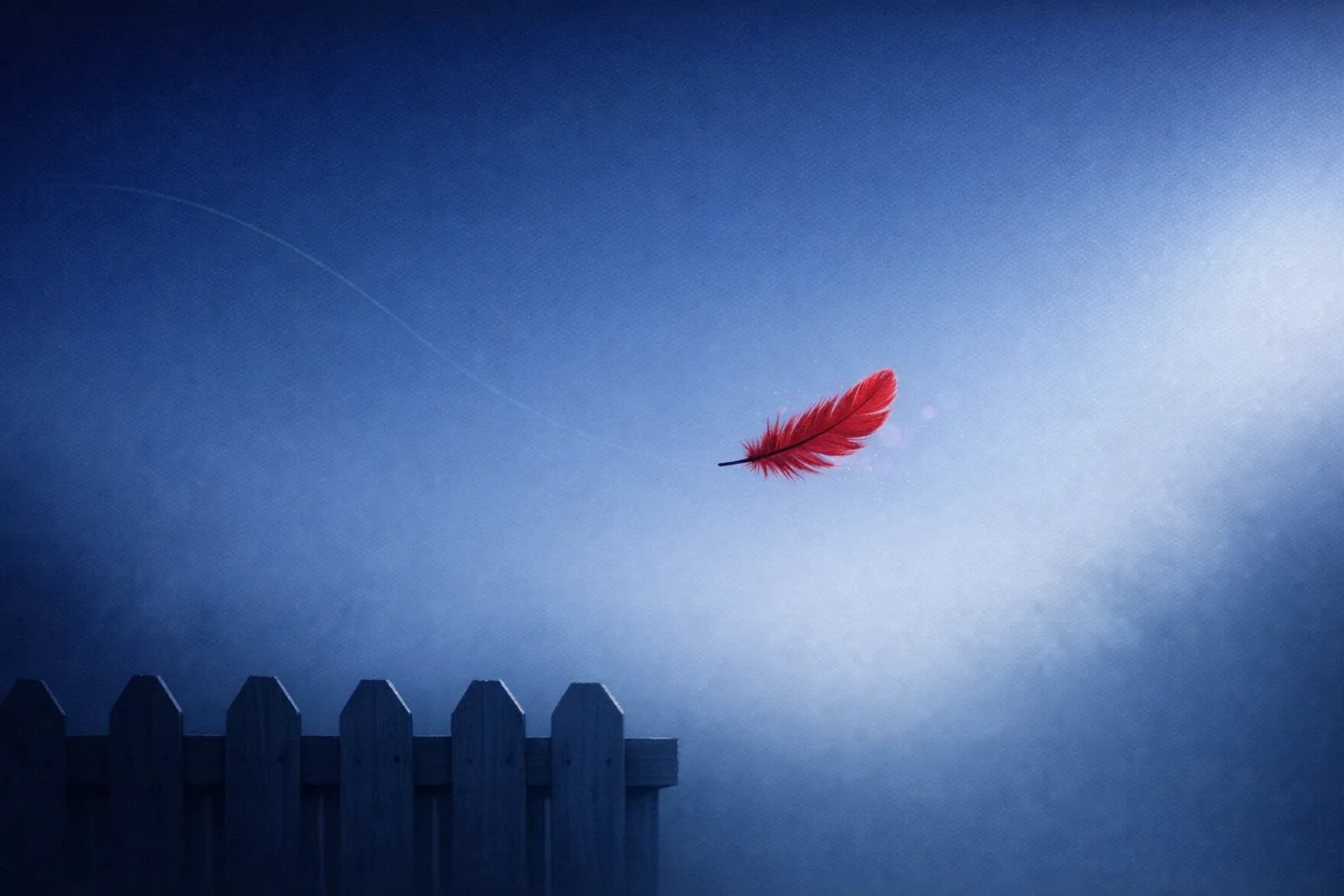
Your anchor example fits right in. Imagine midnight. Backyard. You’re still as a stone in a tide pool. A gust arrives, uninvited but not unfriendly, and drops a single red feather in your lap. Is it just a feather? Yes – and that’s the fun. Omens don’t subtract reality; they add meaning. If the feather makes a thought flare – courage, fire, that person you’ve been avoiding – then the game is on. You can hold skepticism in one hand and wonder in the other. New moons are excellent jugglers; they’ll keep both in the air while you listen.
So tonight, you’ll set up your sideyard stargate: not a portal made of quartz and LED string lights (unless you want to), but a mindset. The gate swings open when you decide that coincidences are kites, and you’re ready to let the wind teach you how to fly them.
Your Sideyard Stargate Kit
You’ll need less than you think. Keep it scrappy and personal. Begin with a small surface – a step, a blanket, or the lid of a cooler. That’s your “console,” home base for your senses. Bring a notebook or the notes app on your phone, something to mark time, and one symbol set that tickles you: runes, playing cards, a handful of pebbles, a bag of tea leaves, or even fortune-cookie slips you’ve saved because you liked their chutzpah. If you have runes, great; if not, make your own on paper squares or bottle caps. The material doesn’t matter as much as the intention you place in it.
Next, set a simple boundary with the night. A boundary is a polite contract between you and the starry orchestra. It says: “I’m here to listen for thirty minutes, and I’ll take notes like a friendly reporter.” Light a small candle if you like, but the dark is your ally; it sharpens the edges of sound and sensation. If you light incense, pick a scent with a clean arc – rosemary, citrus, or pine – and imagine it tracing a lighthouse beam around your space.
A quick one-sentence glossary: if you hear the term retrograde, it’s when a planet appears to move backward from Earth’s view, stirring old stories; we’re not in that realm tonight. New moon is the hush before the first note, when fresh stories wait their cue.
Place your symbol set to the left, your notebook to the right. Choose a question that behaves like a path, not a trap: “What energy wants to grow next?” is better than “Will X text me by Friday?” Phrase it in a way that invites poetry and practicality to sit side by side.
Finally, allow a playful rule: whatever sensory event happens three times counts as a horn section. Three chirps, three breeze gusts, three car doors – mark it. Your stargate is open when the world feels a touch brighter around the edges, as if each leaf is trying to remember its lines.
The Coincidence Kite Method
Here’s your game board, simple enough to keep you in flow but structured enough to catch the wind:
-
Tune-In Minute: Close your eyes for sixty seconds. Listen outward first (street, insects, far-off talk), then inward (heartbeat, breath, that one anxious to-do box). Name the loudest thing silently: “Crickets.” This is your baseline. You’re an audience member taking your seat.
-
Invitation Line: Whisper your question once, then a phrase like, “Show me through light, leaf, and little sign.” Keep it cozy, not ceremonial. You’re inviting synchronicity to play catch.
-
First Draw: Pull one rune or symbol. If it’s, say, Raido (journey), jot that down. If you’re using homemade tokens, maybe you draw “Spark.” Place it face-up like a conductor’s cue card.
-
Catch the First Kite: Wait for the next spontaneous event. The neighbor’s motion light clicks on, a book on the patio table flutters, a dog barks twice. Note the timing. Pair it with your drawn symbol. Ask a tiny question: “How is ‘Spark’ like this motion light?” Maybe it means initiative lights up when you move. Don’t argue; just note the metaphor that arrives first.
-
Three-Beat Confirmation: If a similar sign appears within ten minutes (another light, another flutter), let that be your second kite string. The third similar event counts as a mini-constellation. On the third, make a tentative sentence: “New beginnings want visibility, and I need to step onto a brighter porch – literally or figuratively.”
-
Close the Loop: Draw a second symbol only if you feel stuck. Otherwise, trust the living environment as your co-reader. End with a small breathy thank-you; gratitude is a tuning peg. Blow out the candle, or, if you kept dark, press your palm to the ground and imagine the message filing itself neatly.
This method isn’t about perfect accuracy; it’s about relationship. Omens are call-and-response. The more you respond (by noticing, jotting, tweaking your next day), the clearer the orchestra plays. If the wind is shy, ask gentler questions. If the wind is rowdy, ask it to speak one at a time.
Rune Breezes, Bird Drummers, and the Red Feather Test
Let’s test the anchor scenario in real time. You draw a rune – Kenaz, the torch, which speaks of illumination and craft. You whisper your invitation. Midnight slips a red feather into your lap. Here’s what happens next:
- Immediate image: Torch + red feather. Firebird. Courage in color. Creative heat landing unannounced.
- Sensory echo: Your porch light flickers once. Later, the same gust returns and lifts the corner of your notes, just enough to show a doodle you made earlier of a doorway. That’s two beats.
- Third beat: A cardinal lands on the fence, just long enough to make eye contact. Triple red. There’s your constellation.
Now phrase it. “The new moon asks for brave making. The red is not danger, it’s a signal flare: create boldly, show your work.” If you still feel hesitant, draw a second token. Suppose it’s Algiz (protection) or your homemade “Shield.” That frames the message: “You can be visible and safe. Set healthy rails, then light the torch.”
What if the feather is blue? Blue shifts it to clarity, voice, calm nerve. If no bird shows and the light doesn’t flicker, but your phone buzzes with a message from a friend nicknamed “Red,” the orchestra has swapped instruments but kept the melody. Stay with the family of meanings rather than a single literal track.
For runes in general: if you’re new, keep it breezy. Raidho (travel), Wunjo (joy), Isa (ice – pause), Eiwaz (yew – transformation), Sowilo (sun – victory). Let the night match the rune with a scene: a passing car = movement; a stillness between breezes = ice; a neighbor bursts into laughter = joy. The pairing makes metaphors that are yours, not carved in stone. You’re composing a pocket myth with the sky as your studio.
And if nothing at all happens? That’s a message too: Isa. Hold. The composition is rest, not crescendo. Try again tomorrow, earlier in the evening, or change your question to a softer lens.
Making Meaning Without Getting Stuck
It’s tempting to overfit every creak into a prophecy. Here’s a trick: let meaning be layered, not laser-etched. Think of interpretations like kites on different strings. A short string is actionable – something you can do in the next 24 hours. A medium string is reflective – something to journal about this week. A long string is archetypal – something that shapes your season. The same omen can carry all three.
Example: You hear three distant train horns after pulling Raidho (journey).
- Short string: Map a new route to work; try a different café.
- Medium string: Ask where you’re resisting momentum; write down one fear of change.
- Long string: Commit to a learning path that moves your identity a station or two – a class, a move, a public project.
A mini-ritual to keep you nimble and not knotted:
- Before sleep, place your symbol from the night on your nightstand.
- In the morning, look for its echo in daylight: a book title, a color, a phrase overheard.
- If the echo appears, do one small thing aligned with it before noon.
- If the echo doesn’t appear, release it. Not all kites want to fly every day.
Also, pass on doom. The new moon isn’t a stern headmaster; it’s a patient music teacher. Ominous feelings are often just unplayed notes. If an image unsettles you – a sudden crow call after drawing Hagalaz (disruption) – ground it with care: a glass of water, a handful of salt sprinkled at your threshold, a boundary sentence like “Only helpful messages through.” You’re the conductor. The brass can be bold without blaring in your ear.
Remember, coincidence is the universe practicing small talk. Let it be charming. Smile when it rhymes. Double-check big choices with practical sense – sleep on contracts, read the fine print. Magic loves a well-rested brain.
From Omens to Moves: Your New Moon Score
Play is cute; integration is power. The new moon loves to seed, but seeds like soil that follows through. After your session, you’ll have a page of tiny scenes and a few sketched meanings. Translate them into a “score” for the next two weeks – the new moon to the first crescent build.
Try this simple conversion:
- Pick three notes from your log (e.g., red feather + torch, triple breeze before your friend’s name, still pond of silence after you asked about rest).
- Write one action beside each. Keep it specific, measurable, friendly. “Share one work-in-progress on Wednesday,” “Message the friend by 5 p.m. Tuesday,” “Block two quiet hours Sunday.”
As you move through the week, let daylight offer encores. Maybe the grocery store plays a song you associate with an old goal right as you pass the olive oil. That’s not your cue to buy twelve jars; it’s your cue to hum, remember, and pick one next step. The starry orchestra doesn’t demand; it invites. It flirts. When you respond, it raises an eyebrow and offers another bar.
If you like accountability with a sprinkle of enchantment, pair your practical list with a charm. Tape a red thread to your notebook edge for courage. Slip a pebble into your pocket for grounding. Each time you touch it, ask, “Which note is next?” If you’re more digital, set a calendar reminder labeled with your symbol word – Torch at 3:30.
And yes, if you reach a knot that won’t untie, invite a second set of ears. A friend can read your log with fresh metaphors. Or go for a brief psychic reading to hear how another intuitive maps your orchestra. You’re not outsourcing your song; you’re borrowing a tuning fork.
New moon to crescent is a tender span. Stay generous with yourself. If you miss a cue, the sky doesn’t revoke your membership. The players vamp until you return. The baton waits in your palm.
Closing the Gate, Keeping the Music
At the end of your window – thirty minutes or the length of two tea mugs – close your sideyard stargate the way you opened it: lightly. Blow out the candle if you used one, or simply say, “Thank you, keep safe, see you soon.” That small endcap teaches your attention rhythm. It tells your psyche when to be porous and when to be private.
Store your symbols in a pouch or a jar that makes a little sound, like shells or buttons clinking. Sound imprints memory. Next time you shake it, your body will remember tonight’s hush and ease back into listening mode more quickly. Tuck your notes somewhere reachable. If you’re sparse with words, consider sketching one image from your session: the feather, the porch light, the cardinal glance. Sketches are durable spells; they carry moods better than tidy sentences.
If you live where the night is noisy, don’t frame it as a problem; frame it as a richer orchestra. City hums are cellos. Sirens are trumpets in a minor key. A bus braking is a cymbal swish. You’re not straining for silence; you’re choosing what stands out like a bright star in a crowded sky.
On nights when clouds hide everything, work with texture instead of sight. Let your fingertips read the deck chair’s metal, the tree’s bark, the seam of your jeans. Texture has messages too: smooth says glide; rough says refine; warm says act now; cool says wait. If the wind is rude, laugh. The cosmos loves a good-natured player.
Finally, remember the secret at the heart of omen-play: you’re training your attention to be a loving translator. You’re not forcing meaning; you’re letting meaning find you like a kite string tapping your wrist. The new moon is a promise that beginnings can be small and still be holy. Tonight, the orchestra tuned, and you were there to hear it. Tomorrow, you’ll hum a bar as you tie your shoes, and the day will harmonize. Keep the gate; keep the music. The stars approve of your curiosity. The wind is already writing your encore.

