Chasing Moonlit Inspirations
I’ll admit it: I used to schedule my creativity like a dentist appointment – sharp at ten, please bring two metaphors and a clean protagonist. Then the waxing crescent kept intruding on my calendar with a mischievous grin. This slim, silver grin is the Moon’s early-stage yes; it’s the chapter one curl of a story, the soft ignition of a match that knows it wants to be a bonfire but hasn’t told the neighbors yet. In astrology, the waxing crescent is the stretch after the New Moon – a gathering of intention, not yet fully formed, where the gut whispers louder than the clock. If the New Moon is a blank page, the waxing crescent is your pen picking itself up, tugging your wrist, suggesting the first sentence.
On these nights, I notice “clues” that feel like breadcrumbs in the Muse’s labyrinth: a line in a stranger’s conversation that tugs a thread in my chest, the way steam swirls in tea like a wet fingerprint from some unseen hand, the soft insistence of a color I start seeing everywhere – cobalt, rust, a defiant marigold. The cues are ordinary but slanted; they glitter slightly if you tilt your head. I used to dismiss them. Now I translate them. This is where tarot sidles in.
Tarot, for me, isn’t a rulebook; it’s a language for those twilight hunches that don’t fit in a spreadsheet. It meets the waxing crescent in a shared dialect. A single card can say, “Don’t just look – follow.” That’s the hook that drags me off the main road and into a side-quest. And side-quests are where the good stories hide their elbows. When the Moon is smiling thinly and the sky is rinsed with peach and navy, I’ll shuffle a deck at my windowsill. Not to predict the future; to eavesdrop on it. The deck reflects my inner weather, framing it as a symbol I can carry into the street like a password. Inevitably, the city answers back.
The Call of the Waxing Crescent
When the Moon is young and gathering light, our creative momentum learns to breathe again. This phase is like a hallway lined with doors that aren’t locked, just shy. You don’t batter them open. You knock, wait, and then trust the hinge. The waxing crescent says: begin, but gently. The work you start now doesn’t have to know who it will become. It only needs to know that it wants to go somewhere. That open-ended promise can be maddening if you crave crisp certainty, but it’s perfect soil for imaginative detours.
Here’s how the phase feels in the body: a tug behind the ribs, a lean toward new colors, a restlessness that isn’t fatigue but an elastic curiosity. If you’re sensitive to lunar rhythms, you might notice you move differently through an evening errand – soft-shoed, attentive to scent and shadow. Even a simple walk can acquire a quest-like shimmer. The waxing crescent doesn’t shout; it leaves chalk symbols at the street corner. In practical terms, this is an excellent window for small vows and nimble experiments. Not five-year plans, not sweeping resolutions – just a sketch, a prompt, an invitation.
I like to treat this slice of the month as a listening tour. Ask a question you don’t have the answer to – How could I make this project feel more like play? What if my next character refuses to speak plainly? – and then let the evening answer with images, overheard phrases, a sudden desire to turn left instead of right. Think of the Moon as your backstage pass to your own intuition. If “retrograde” means a planet appears to move backward and we review old lessons, the waxing crescent is forward tilt – compass-pointing, spark-collecting, the rehearsal before the lights rise. You don’t need to see the destination; you just need to give the first few steps a name. And if the name turns out to be wrong tomorrow, perfect. That’s the kind of mistake the crescent teaches in gold ink.
Dancing With the Tarot
Twilight, card backs glimmering like fish scales – this is when the tarot becomes kinetic. I think of each suit as a doorway to a different wing of the labyrinth: Cups for feeling and imagination, Wands for spark and momentum, Swords for clarity and language, Pentacles for form and craft. During the waxing crescent, Cups and Wands often take the lead, because the creative cauldron is simmering and your inner fire is bright but uncommitted. When I shuffle, I ask for a nudge, not a verdict. The deck, mischievous aunt that it is, delights in giving me a riddle with a flashlight.
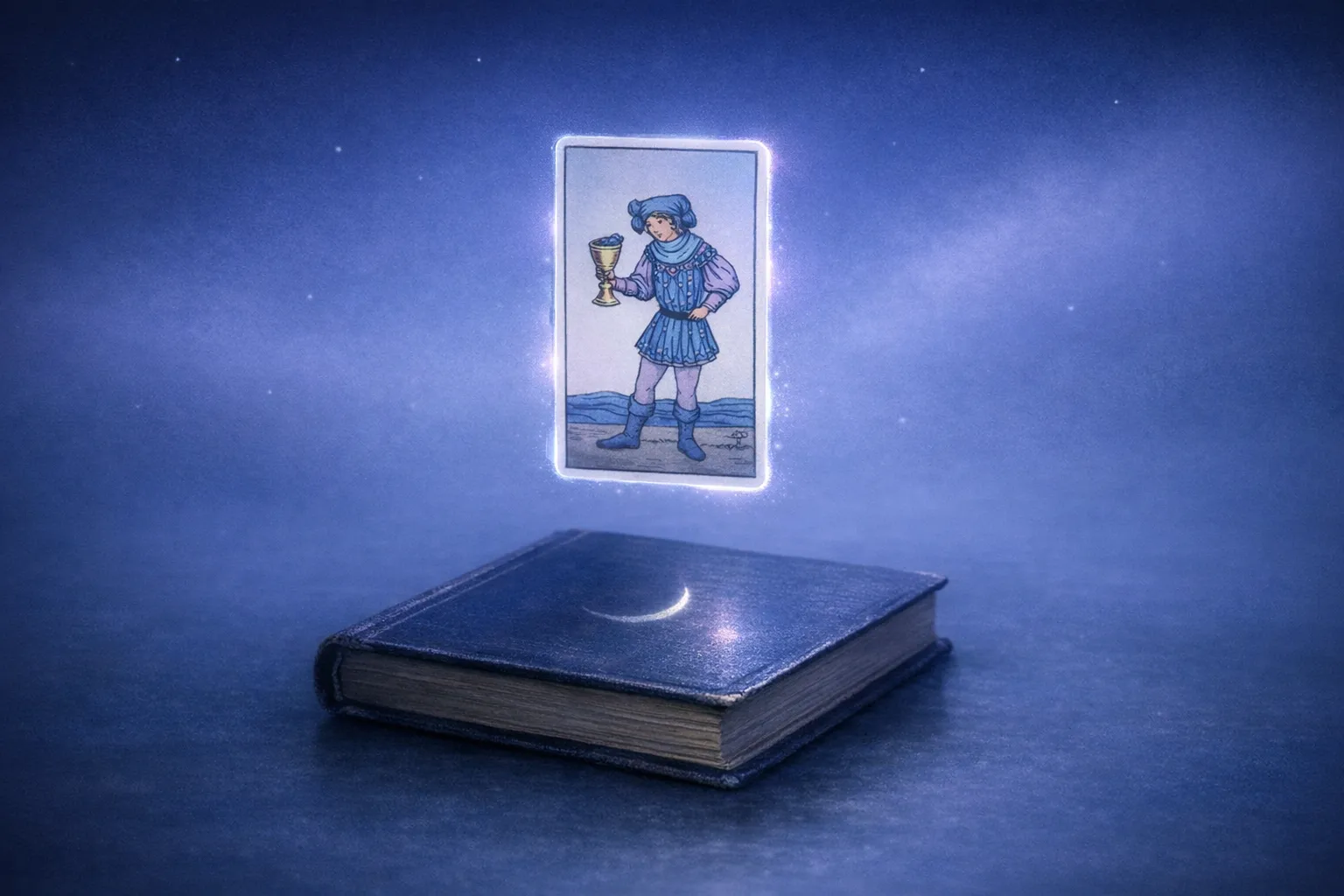
The Page of Cups in particular is the side-quest patron saint. Pages are students – fresh wind at the edge of a map – and Cups soak up wonder like rain. When the Page arrives, I prepare for a tender surprise: a melody I haven’t heard yet, a motif bobbing like a bottle in the tide. Pages don’t boss you around; they beckon. They’re the invitation to treat coincidence as choreography for one evening. The suit’s watery quality also asks for receptivity. Don’t sprint across the bridge; listen for the creek’s gossip.
The anchor case that lands in my notebook again and again: I pull the Page of Cups at sunset, the city sliding into indigo, and feel my chest bloom with that fizzy, almost childlike yes. I step outside with no destination, and the alleys begin to edit themselves – less menace, more mystery. A smell of paper and dust tugs me right. There, a narrow bookshop with a bell that sounds like a teacup being tapped. I’ve lived in this neighborhood for years, yet this shop has somehow stayed in the blind spot of familiarity. Inside, the shelves lean together like co-conspirators. Without trying, I find a strange little volume bound in green linen, illustrations of constellations annotated in a hand like a river. That book becomes the key to a stubborn character, or the title of a poem, or at least a courage I didn’t realize I’d misplaced. The Page of Cups doesn’t guarantee treasure; it teaches you how to notice it.
Mini-break: Myth vs. Reality of “Signs”
- Myth: A “sign” will be thunderously obvious and one-time-only. Reality: Most signs are faint harmonies that repeat until you hum along.
- Myth: If you miss a sign, you’ve failed your destiny. Reality: The Muse is patient; she reroutes like a good map app.
- Myth: Tarot dictates outcomes. Reality: Tarot frames choices so your intuition can vote clearly.
- Myth: Lunar timing is a rigid schedule. Reality: It’s a mood calendar; show up when the vibe fits and ignore when it doesn’t.
The Page of Cups as Field Guide
If the waxing crescent is the hallway with shy doors, the Page of Cups is the small, polite knock. Think of them as your inner apprentice, squinting at the surface of experience and saying, “There’s a drawing under this drawing.” The Page shows up when creativity wants to learn by wandering. They’re the friend who texts, Bring a notebook, we’re taking the scenic route. There’s humor in their innocence but never folly; the Page trusts curiosity the way a compass trusts north.
In practice, working with the Page during the waxing crescent can be delightfully low-stakes. You’re not signing a contract with your magnum opus – you’re leaving breadcrumbs for it. Let the Page teach you to flirt with possibility. If a cafe you’ve passed a hundred times suddenly glows with a lamplight that looks like an amber chandelier in a dream, go in. If a street musician plays a song you can’t place, ask for the title and write it on your wrist. Small gestures carry seeds. The Page loves vessels – cups, bowls, teacups, fountains – so I notice where liquid gathers on these walks: rain in a pothole reflecting a sliver of moon, a glass of water left on a windowsill catching dusk, the shimmer of an aquarium in a restaurant lobby. Each pocket of water feels like a tiny scrying mirror, not to predict but to remind me that depth can be held in the palm.
Here’s a petite ritual I use under the waxing crescent when the Page appears:
- Fill a cup with water and hold it at the window. Name one tiny creative risk you’re willing to take before the Moon is full.
- Draw a single tarot card. Ask, “What companion quality will help me follow the thread?” If it’s a Cup, lean into feeling; a Wand, into brave action; a Sword, into naming the idea; a Pentacle, into making a small, physical change.
- Sip. Then take one literal step outside – onto a porch, a sidewalk, a hallway – and let the first unusual sensory cue decide your route for ten minutes.
That’s how I once ended up at a bookshop I swear was hiding in plain sight, guided by the sweet persistence of the Page. And yes, the green-linen tome found me. More importantly, the tone of wonder it unlocked found its way into my draft the next morning – lighter, kinder, somehow braver.
Mapping Your Own Sunset Side-Quests
This is where the case study turns into your compass. The waxing crescent doesn’t demand theatrical pilgrimages; it welcomes humble fieldwork. The practice is to say yes to a small detour and then read the world as if it’s been annotated for you in soft pencil. I like to set a time boundary – twenty to forty minutes at twilight – and a question that my current project is stuck on. Then I pull a card. If the Empress arrives, I look for evidence of lushness and care; if the Hermit, I pay attention to quiet corners and self-contained lights; if the Page of Cups, I court whimsy. The city becomes a deck I can walk through: graffiti as archetype, overheard jokes as oracles, window displays as mood boards. If you live outside the city, even better – fields and fences and kitchen tables carry their own mythic echoes. A moth circling a porch bulb has the same narrative heft as a constellation; the porch is just a smaller sky.
You don’t have to chase a perfect omen. Follow the first thread that piques your inner Page. What you’re really practicing is muscle memory for curiosity. Creativity often stalls not because we lack ideas, but because we forget how to move toward them without interrogating them to death. The waxing crescent is permission to approach the unknown with a lighter touch, to court coincidence like a dance partner rather than cross-examining it under a spotlight. Bring a pocket notebook or use your phone’s voice memo. Catch fragments, not essays – colors, textures, snippets of dialogue, a title for something you haven’t written yet. Then, when the Moon fattens and your energy asks for structure, those fragments become scaffolding you can climb.
If you like company for these rambles, invite a friend and compare what each of you noticed. Perception multiplies in good company. Or, if solitude sings louder, keep it sacred: a half-hour that belongs to your beginner mind. And if you’d like a little extra spark on the path, consider booking a quick psychic reading to frame your detour with a symbolic theme for the week. Not as a rulebook – just another friendly signpost in the alleys of your Muse’s labyrinth. When you get home, place your found token – a ticket stub, a leaf, the receipt from that surprise bookshop – near your deck. Let it remind you that the hallway of doors is still there, and your knock has grown confident.
When the Moon slips another notch toward fullness, look back at your notes. Notice which images repeated, which names kept tapping on the window, which street corners felt like déjà vu. That’s your breadcrumb constellation. That’s where your next chapter is probably loitering, trying on new hats. And you – pen in hand, Page in pocket – are already walking toward it, nose tuned to the secret cinnamon in the air, willing to get a little lost so the story can find you.

