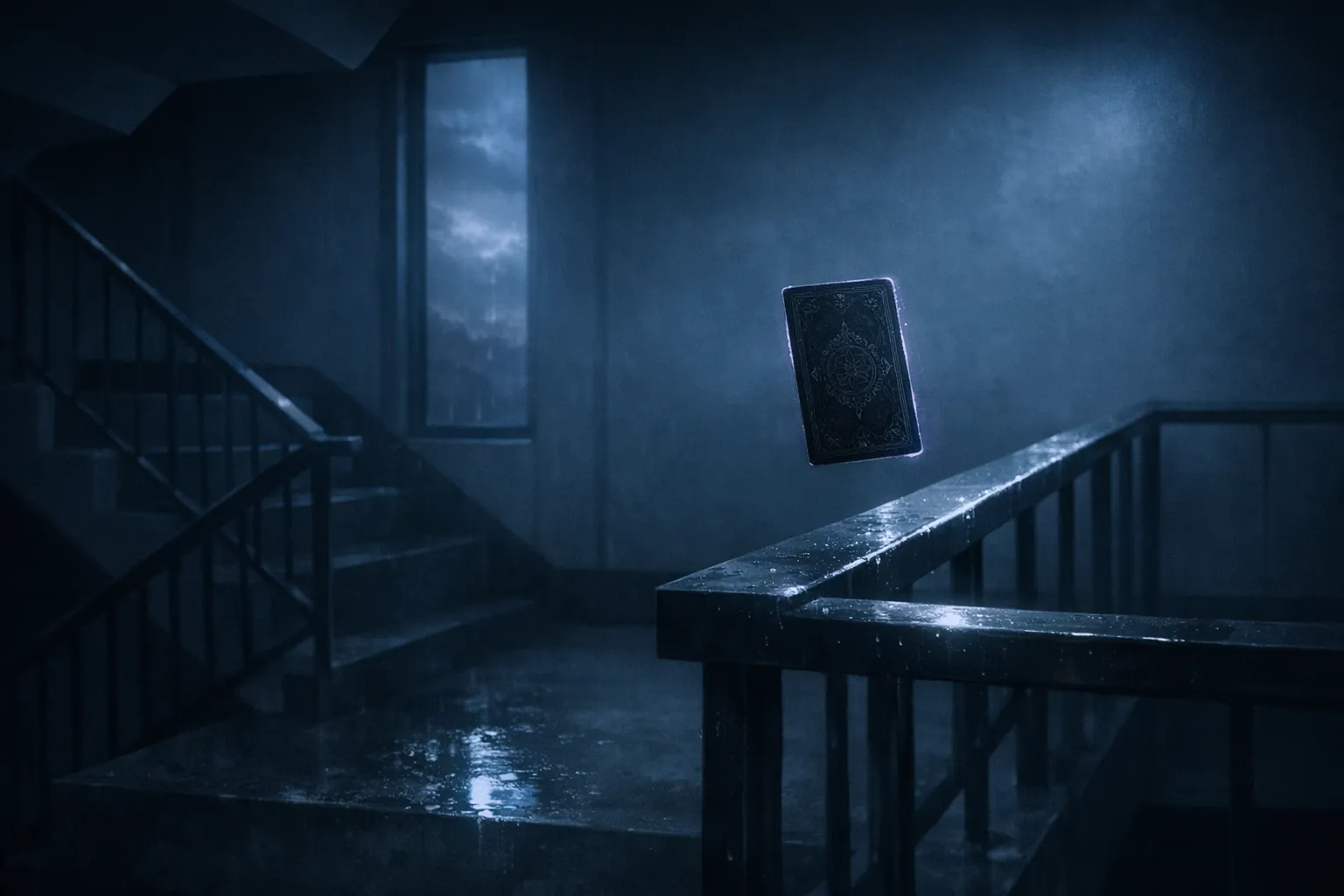
Stormy Stairwell Divination
The stairwell turns cavernous when thunder moves in. Concrete breathes like a sleeping whale, and the whispering winds thread themselves through the handrails, telling gossip from rooftop chimneys and alleyway drains. I like to pause on the landing halfway between floors, where the echo holds a secret a moment longer, and the lightning paints temporary windows on the wall. It’s here that a one-card tarot pull feels less like an act and more like a conversation, the kind you have with weather when it takes your old language and shakes it down to its bones.
A storm does not ask permission to arrive; it simply opens the door and sets down its suitcase of electricity. Eclipse season, with its shadowy velvet and sudden reveals, loves the same kind of entrance. An eclipse is just the sky practicing dramatic pauses – light, then not-light, then the kind of hush that asks you to lean closer. When that energy syncs with thunder, the whole atmosphere becomes a reading room. The stairwell accepts the role of listener, and the deck – tucked in your pocket, in a scarf, maybe rubber-banded with a bus ticket – becomes an antenna.
I’ve met readers who swear the cards speak louder on the fifth floor than the third. One musician says she hears chord progressions in the rain and flips a single card to name them. A janitor I chatted with confessed that during storms, he pulls a card on his break and never peeks until the elevator dings again: “If the Tower’s there, I know which pipe to fix first.” I nod because it makes sense. Storms carry archetypes in their coat pockets. They hand you The Fool as a sudden gust on an unlatched door, The Moon as a puddle that’s deeper than it looks, The Star as the shimmer on wet concrete once the clouds have wept their fill.
In the stairwell, the handrail is your staff, the landing your stage, and the wind a choir muffled by cinderblock. You pull one card, not because you need fewer answers, but because storms prefer simple questions answered honestly. The sky is thundering. What is the heart thundering back?
Crackling Sky Ritual
Imagine the energy of an eclipse, with its charged mystique mirrored in the booming skies, urging you to pull a card as lightning strikes. I don’t mean you must time it like a game show buzzer; I mean to let the strike set your metronome. The whole city counts along – ceilings, gutters, bicycle spokes. The winds whisper over the steps, like pages turned by someone who reads faster than you. In this theater, ritual doesn’t need incense or bells. It needs presence.
I start with a pause at the landing where the storm sounds most round, as if the stairwell were a conch shell and I could hear the ocean of clouds. I tap the deck three times on my palm – three is the number that opens a door and keeps it open. Breath in. Breath out. The thunder rolls its barrels down the hall of the sky, and when it fades, I ask a question I can carry in one hand: What wants to be revealed? Then I shuffle, not as a machine of precision, but as a friend letting the cards loosen their throats. A staircase is full of thresholds, and thresholds adore questions that don’t try to win.
The eclipse part matters only as poetry. Eclipses remind us that visibility is a dance with shadow. Tarot already knows this language. In one card, both light and dark speak at once. A storm is the exclamation point; the eclipse is the ellipsis. Between them: your listening. When the lightning pops – one Mississippi, two Mississippi – I cut the deck. I wait for the wind to thread a draft between the risers. If a loose card juts out, it volunteers. If not, I flip the top, and the stairwell takes a quick breath with me. People pass, shoes clacking, lives moving in their important arcs, and the ritual stays small, almost invisible, but completely real.
Some readers hum the note the thunder leaves behind. Some press the card to the cool wall and feel its temperature. I like to set the card on the stair like a small moon and watch how the emergency light halos its edges. Rain climbs the window like static. The winds go on whispering. The card clears its throat, ready to speak in weather.
A Single Card of Destiny
Discover how the simplicity of a one-card tarot pull can illuminate hidden truths and provide clarity amidst the stormy chaos. One card is a lighthouse when the barometer drops. It refuses to juggle explanatory footnotes or disguise itself in options. It lands with the confidence of a thunderclap and the intimacy of a handwritten note slipped under your door. A single card doesn’t solve; it concentrates. It holds a slice of the pattern and lets the rest assemble around it like raindrops finding a river.
In interview-style nights, I’ve asked seasoned readers what one-card draws do in storms. “They answer the question I should have asked,” says a soft-spoken chef who keeps her deck in a flour-dusted tin. “They act like a weather vane,” adds a postal worker, grinning as he tucks a joker behind his ear; “not the full forecast, just the direction.” A grad student tells me the single card is her respectful limit: “When the wind is loud, I don’t shout. I listen.” Everyone agrees: the card frames the conversation so the noise becomes music.
Here’s what the archetypes tend to hum during thunder:
- The Tower: Lightning’s autobiography. A toppled expectation, yes, but also the surprise of fresh air. If it arrives, check which floor you were standing on. Sometimes you’re the brick loosened to see sunlight.
- The Star: Rain-washed hope. That fragile sparkle after the power flickers back on. The card that asks you to drink from a quiet puddle of trust.
- The Chariot: Wind that means business. A nudge to steer, even if the road shines slick. Direction isn’t speed; it’s a grip on the reins.
- The Hermit: The stairwell itself, lantern in hand. Solitude that listens, not isolation that sulks.
- The Moon: The rumor of water. Dreams knocking with wet knuckles. Proceed by feel, not by fluorescent certainty.
One card is the stair between two floors – neither here nor there, but exquisitely supported. It suggests the next footfall, not the entire destination. The thunder underlines it. The wind whispers a footnote you can only hear if you lean.
Stairwell Oracles: Voices From The Landings
We gathered stories the way rain gathers under eaves, letting each one spill in its own tempo. In a candlelit interview round – half improvised, half destiny – we asked readers about their thunderclap pulls on dim stair landings.
A night-shift nurse speaks softly, as if her words were warm compresses. “I pull when the hospital generator kicks in. The sound hums like The Emperor – authority restored. Once I flipped Strength right as the thunder popped. I didn’t understand it until my patient squeezed my hand with surprising force. The card was about trust in quiet muscles.”
A theater tech, hair strung with static, laughs. “Lightning loves The Magician. I swear the elevator doors are stage curtains. I’ve pulled the Magician mid-storm and felt my pockets invent tools – gaffer tape, a spare idea, a joke that fixes morale. The winds through the stairwell are like cues whispered from the booth.”
A retiree who photobombs clouds on her morning walks shares this: “The Hanged Man showed up while I waited between floors for the rain to decide. I took it as a pause that teaches. I tried listening to the drip’s rhythm. It slowed me enough to notice the smell of petrichor – how the earth speaks after being kissed.”
A bicycle messenger, cheeks glazed with rain, nods toward the window. “The Chariot’s funny on stairs. It asks movement but respects the climb. Thunder said go; the card said guide. I delivered the package with a detour that avoided a flooded street. Small victory, huge grin.”
And a librarian whispers a secret the winds already know: “The Moon in a stairwell sounds like old conversations trapped in the paint. I don’t chase clarity with a flashlight. I invite curiosity to hold the rail.”
Across these voices, a pattern hums. The stairwell’s architecture creates a small amphitheater for meaning. Each landing is a listening post. The storm offers crescendos; the cards provide melody. Between them, we translate weather into behavior, not as rules but as constellations flickering on the inner eyelid. Even in the squeak of wet sneakers and the thunk of doors, intuition threads a silver seam through the ordinary.
Reading The Weather In The Cards
Tarot and weather are friendly mirrors. Clouds drift like suits across a skyline of possibilities: Cups condense to rain, Swords slice the air, Wands spark like dry tinder, Pentacles settle like river stones. During thunder, each archetype finds its meteorology. Think of it as a symbolic forecast where your heart is the barometer.
When The Fool appears, watch the gust at your back. It’s not a shove; it’s a whistle saying, try the next stair. The Fool is often mistaken for recklessness, but in storms it’s the little trust that your foot will discover the step as it lands. The Hierophant? That’s the building itself – the rules, the structure, the emergency lights that never improvise. In a thunderclap, it asks what traditions keep you steady and which ones lock the doors too tightly.
Temperance is the rain’s patient arithmetic: drop plus drop equals river. If it shows up, mix your extremes on the landing and see what new weather you invent. Death is the clearing wind that sweeps loose leaves to a single corner so you can see the stairs again. Not an ending that scolds; a transition that tidies.
And then there’s Justice, which during a storm becomes a window that fogs equally on both sides. Balance isn’t symmetry; it’s ventilation. Are you letting ideas breathe? The Lovers shifts from romance to alignment – two choices meeting under the same umbrella, deciding to walk in step. The Devil crackles like static: attachment that sticks your wet sleeve to the rail. It doesn’t demand shame, just awareness and a good peel-away.
Readers sometimes ask if Mercury retrograde – those famous weeks when the planet seems to move backward from our view – makes storm readings tricky. Retrograde simply means review mode. It’s the sky saying, “Check your pockets.” In the stairwell, that might translate to rewording your question or flipping your card again only if your first impulse was to overthink. Let the thunder edit; let the wind whisper the title.
If you want a tiny practice, try this: Listen for three distinct storm-sounds (a gutter rattle, a low growl, a sudden hush). Name a card that matches each, then draw one. Where the overlap hums, you’ll find your next step. The method isn’t science; it’s poetry with good shoes.
After The Flash: Keeping The Message
Clarity likes to wander off once the clouds mutter away, so anchor the reading while the stairwell still smells like rain. Storms print their notes in disappearing ink; your job is to trace over them lightly before the page dries. You don’t need a grand archive – just a respectful tether.
Here’s a simple way to carry the echo:
- Give the card a weather name. If you pulled The Star, maybe it’s “Puddle Constellation.” If it’s The Tower, “Lightning’s Honesty.” Naming makes the message portable.
- Pick a micro-action that matches the name. “Puddle Constellation” might be ten minutes of sky-watching between tasks; “Lightning’s Honesty” could be one truthful email, kind but unvarnished.
- Offer the stairwell a thank-you. A fingertip tap on the rail. A nod to the echo. Small gestures keep the channel oiled.
Interviewing a handful of storm-readers later, I asked what lasts after the flash. A barista shrugged, smiling. “I walk different for an hour. If the card was The Chariot, I stride with reins you can’t see. If it was The Hermit, I become a quiet lighthouse in a line of noise.” A professor confessed he keeps a deck in his briefcase “for thunder only.” A dancer texts herself the card’s weather name; those messages become choreography seeds.
If, in the final third of the downpour, you feel tugged toward deeper dives, that’s when a single conversation can widen the map – whether with your own journal, a friend who speaks fluent clouds, or a gentle psychic reading that helps translate the hush between rumbles. Keep it simple. Let the insight fit in your pocket next to the keys. You’re not capturing the storm. You’re befriending the way it tunes your listening.
When the building settles back into fluorescent concentration, your one-card pull remains a tiny barometer in the chest. The whispering winds taper to a private breeze, carrying a last message down the stairwell spine: Remember how the thunder said your name like a drum and you answered with a card that glowed? Keep answering, even when the sky goes quiet.

